Today I finally got the opportunity to be a tourist in Antigua! I had seen information on tours in Antigua hosted by a tour company created by Elizabeth Bell, an American woman who came to Guatemala at the age of 14 and who has more or less lived here the last 40+ years.
The tour was exactly what I was hoping for – excellent insight into Guatemalan history, the cultural life in Antigua, and sights around the city I wouldn’t have otherwise seen. I can’t even cover all the stuff we saw and learned, but here are some of the highlights…
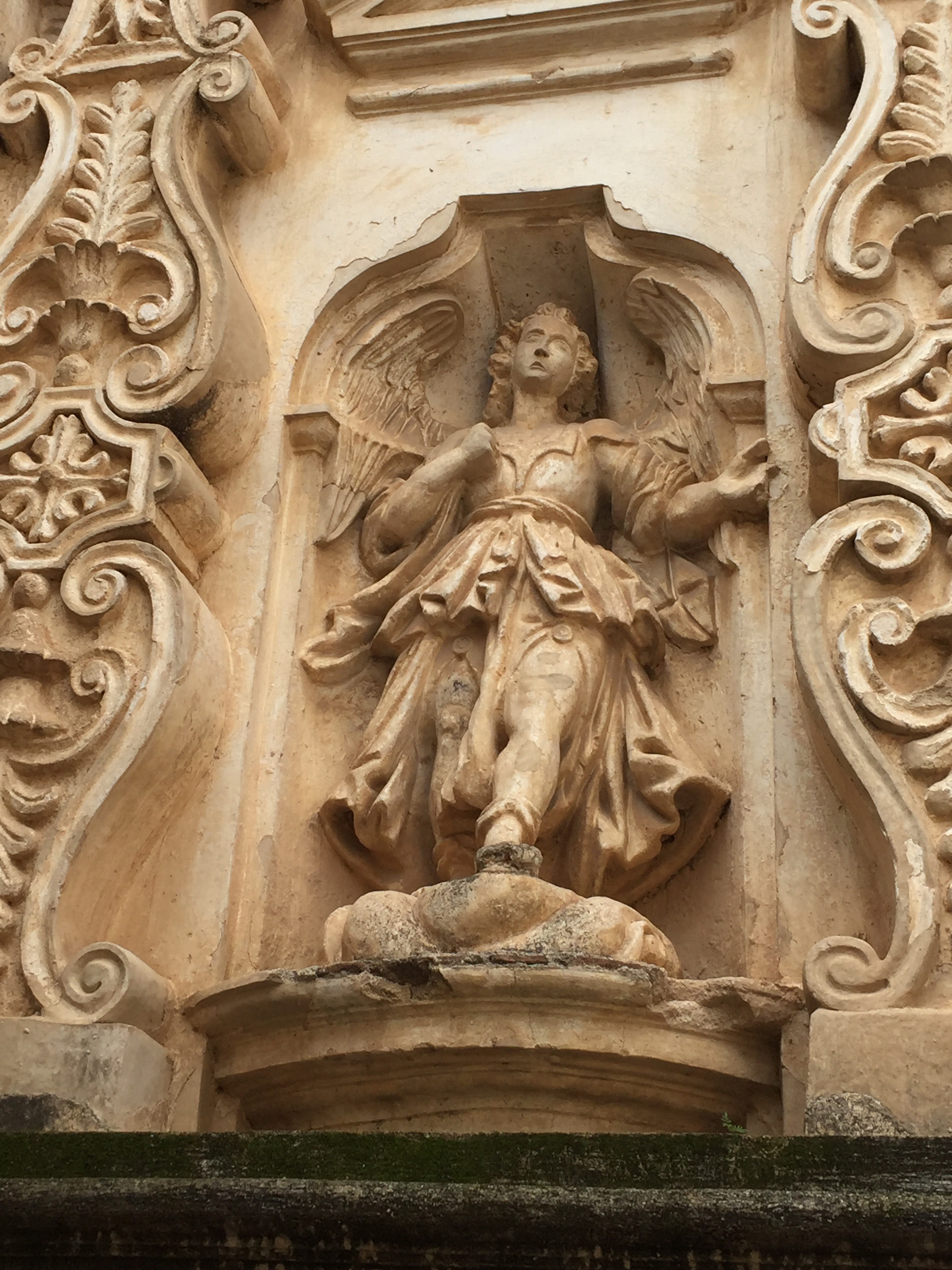
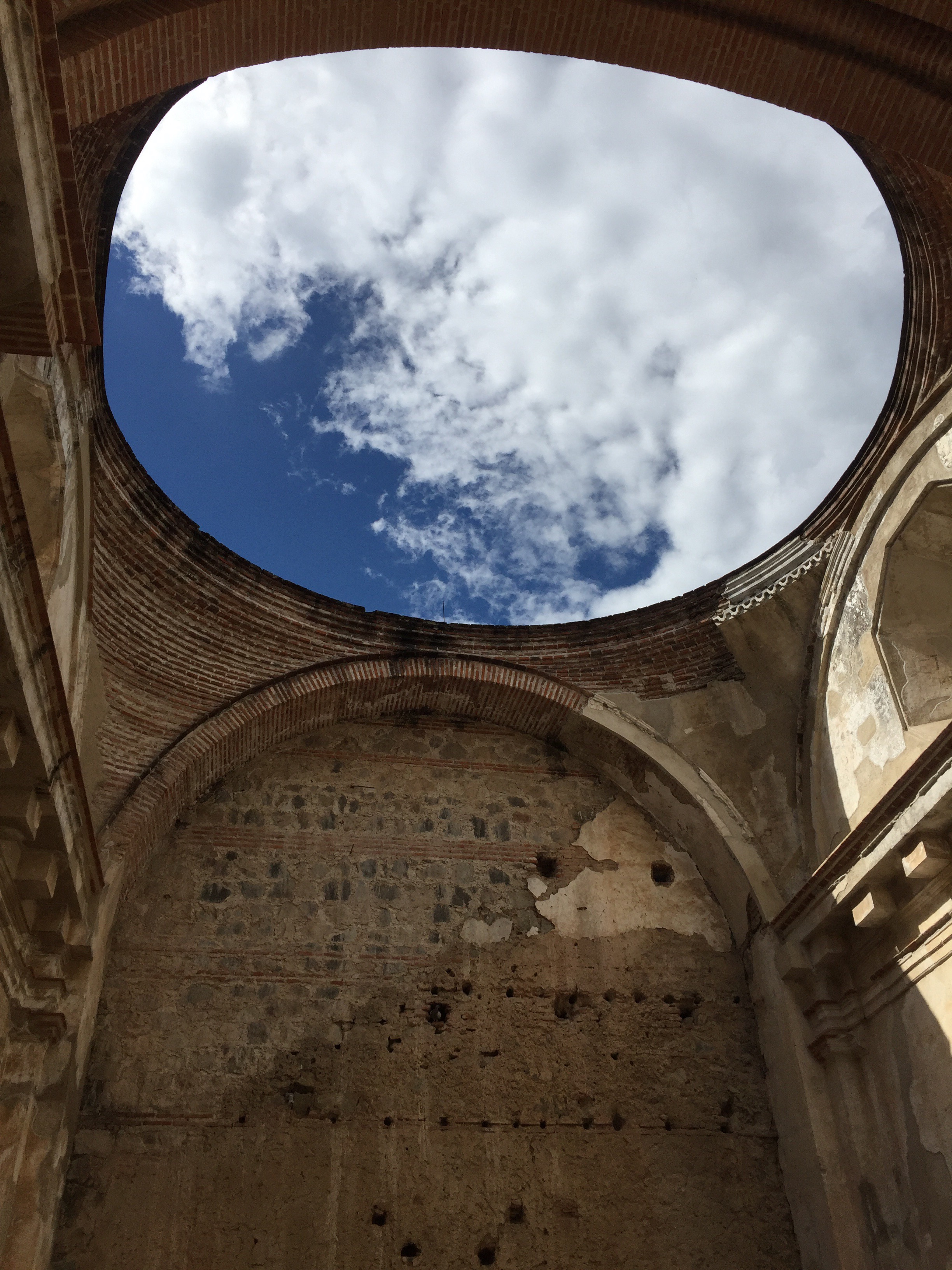
These pictures are ruins of the old cathedral behind the main church off Parque Central (which my housemates and I affectionately refer to as Central Park, a reference that makes me laugh a little inside each time I hear it because this Central Park is tiny).
I had been into the church already, and I was confused about it not being a typical cathedral – like not in the layout of a cross, for example. Entering the ruins behind explained that to me. They were your very typical cathedral – cross layout, way bigger than the church (but smaller than the typical European cathedral).
This also finally helped me realize why Antigua has so many ruins. When you know why, it’s obvious, but otherwise it seems weird that you can turn a corner and stumble onto ruins basically anywhere in the city. The big earthquake of 1776 took out churches across the city. Any columns and arches basically fell. You can see the column left where it fell in the one photo above. The ruins are being preserved (not restored, just strengthened), but that column is left as an example.
Before the earthquake there were 36 churches in Antigua. Now there are just 16. The earthquake took out churches and houses, and the Spanish decided to move the capital from Antigua to Guatemala City. Antigua was sort of abandoned, except by the people who were too poor to move. They stayed, moving into houses of rich people who had left and taken all of their goods. Buildings were left to fall into even greater disrepair. Some of the churches and monasteries had crops cultivated in their open spaces. This is when Antigua also got its new name. Antigua means former, as in the former capital.
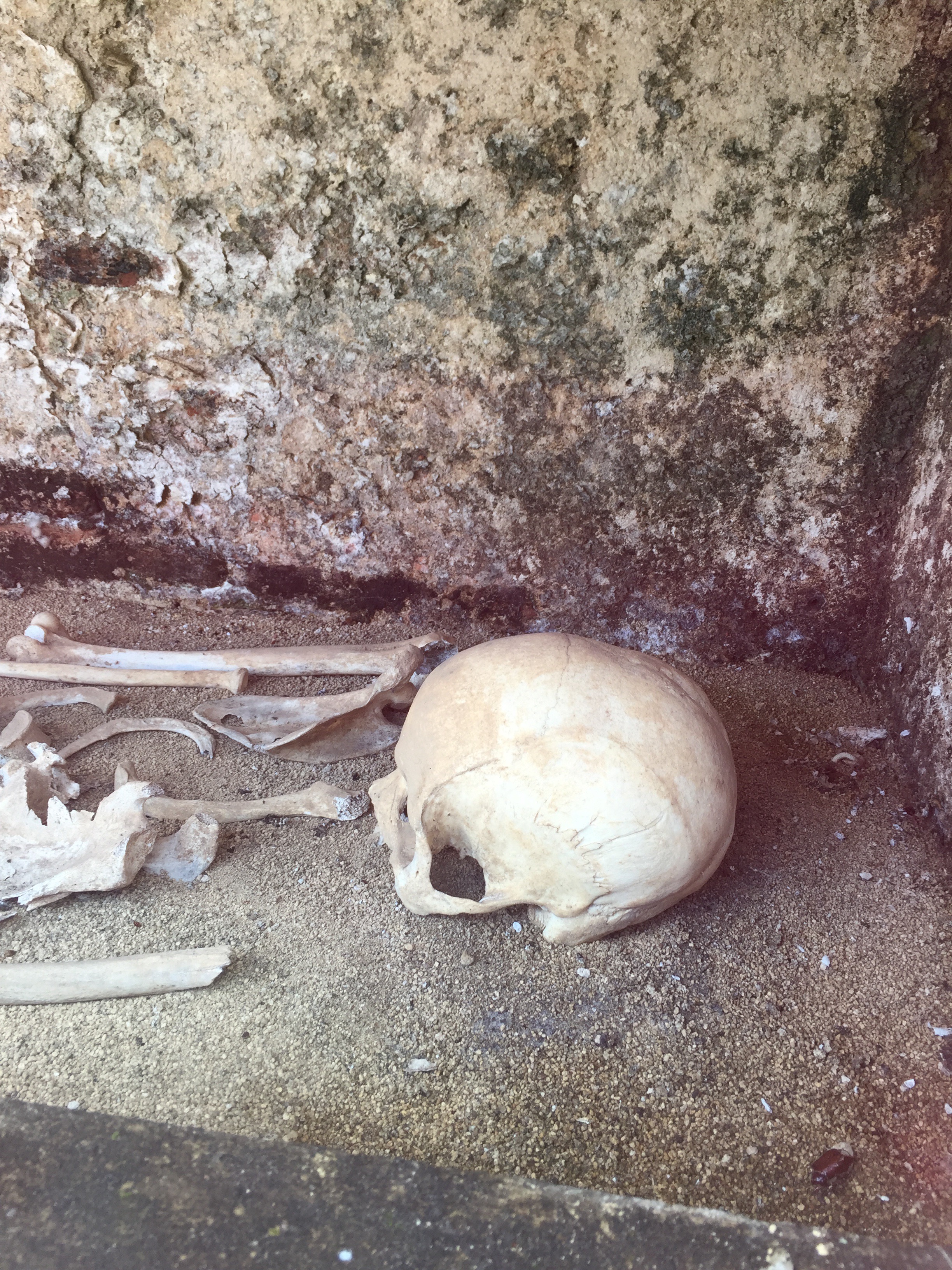
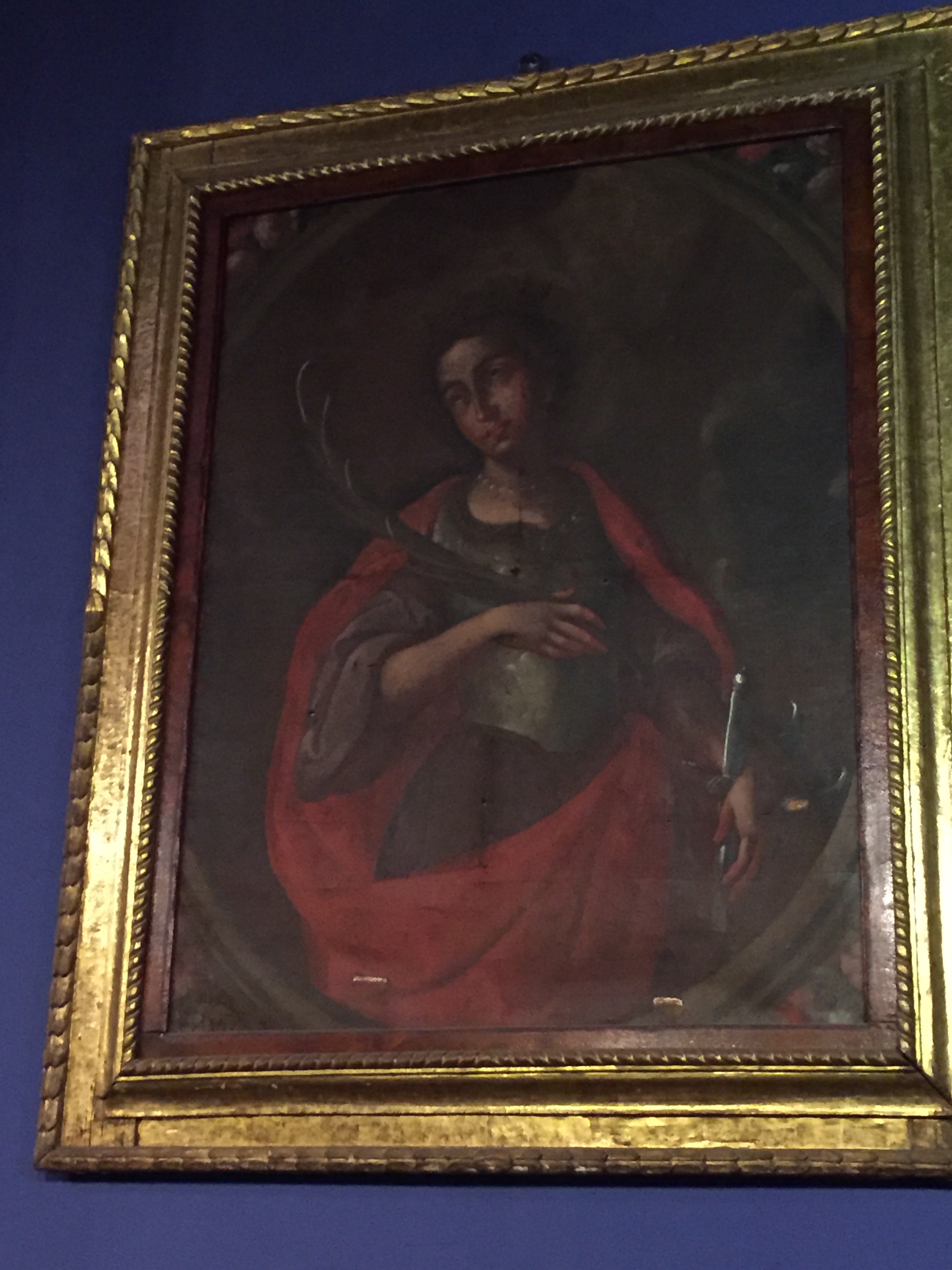
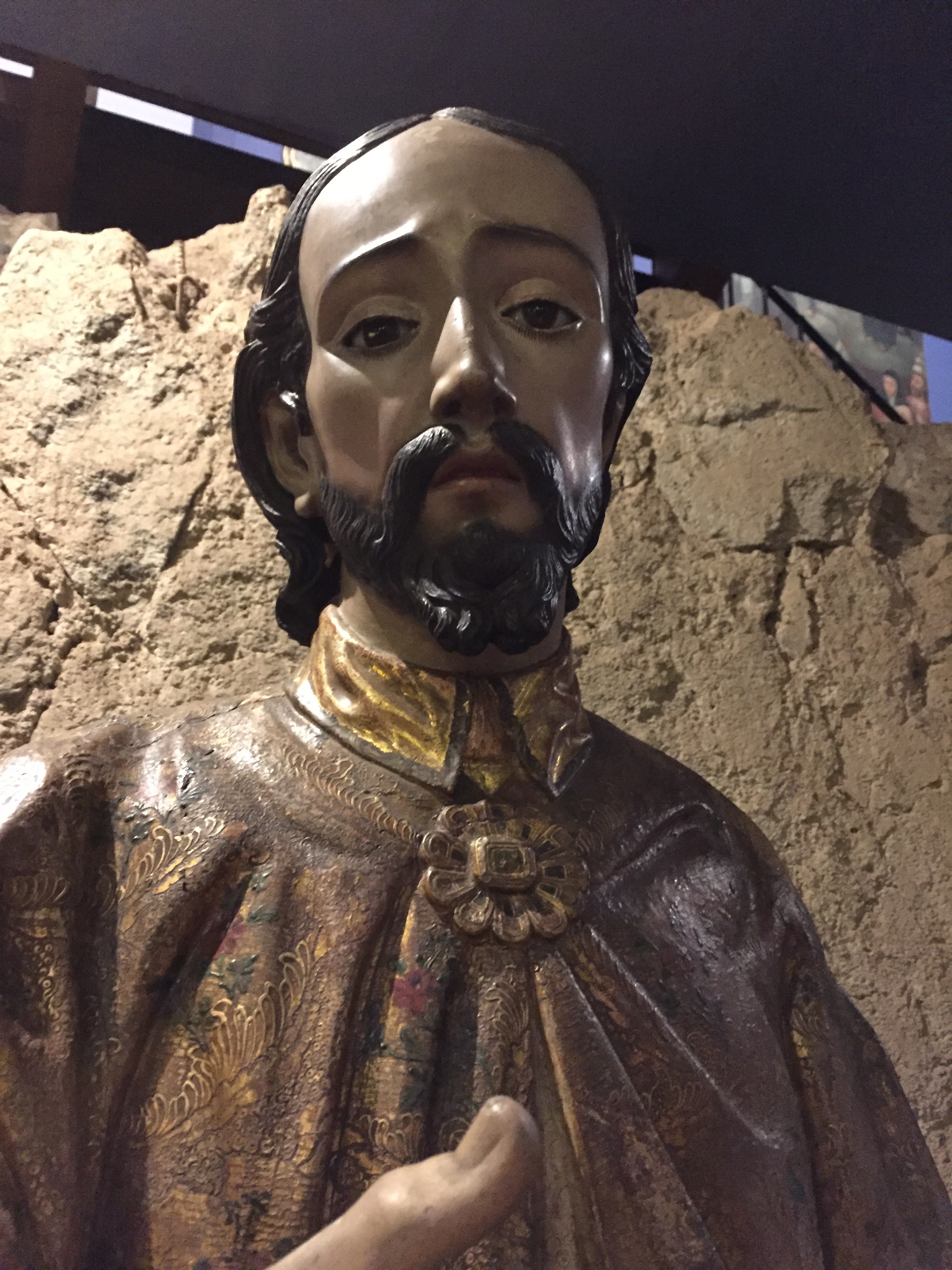
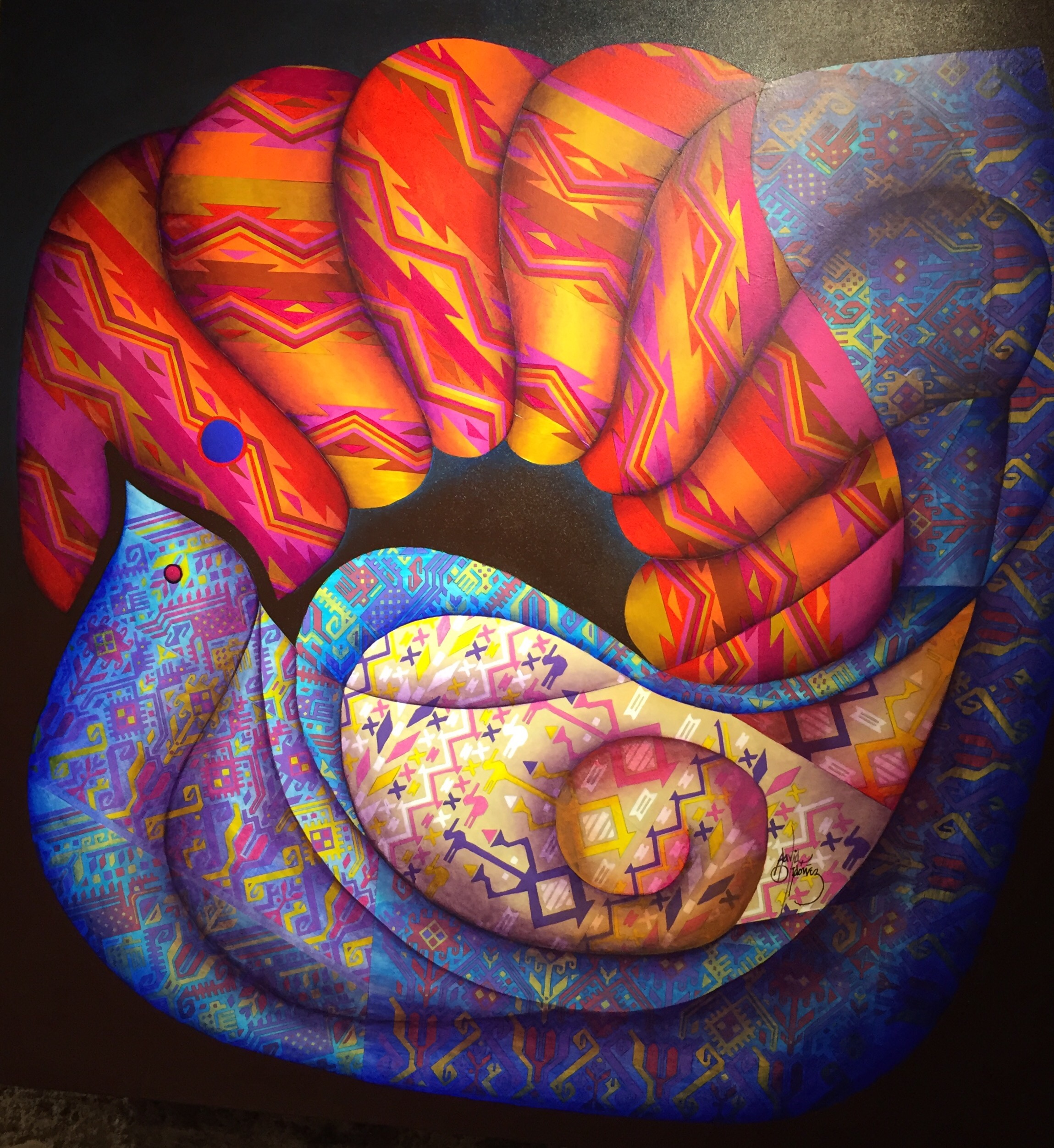
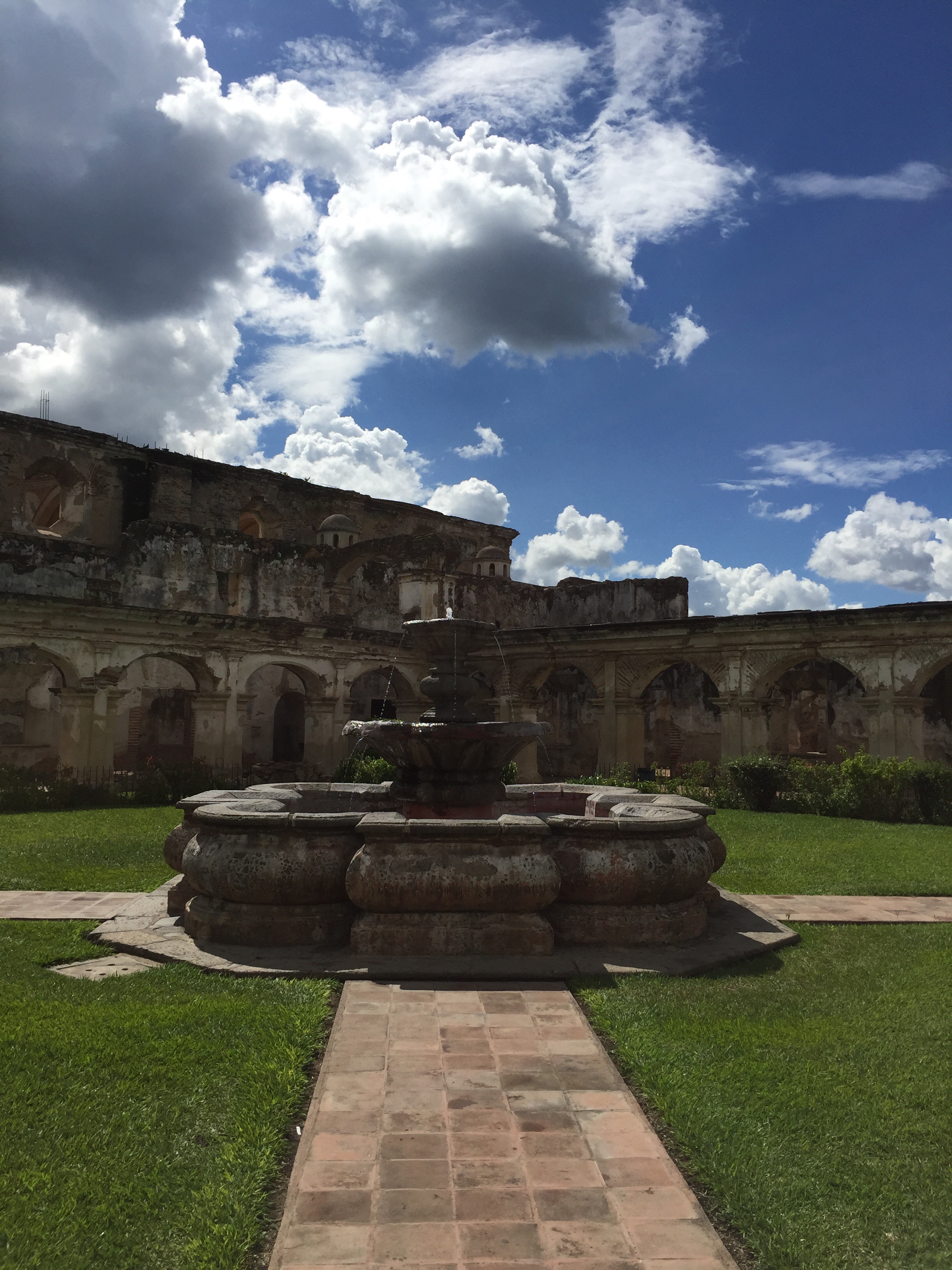
From the cathedral ruins, we got to visit a jade store and museum and find out about the jade industry in the Ancient Mayan civilization and now. Then we went to a former monastery that was abandoned and filled in with dirt and garbage. In the 1980s and 1990s it was bought and restored into a hotel. More and more land was purchased around the monastery, and the hotel has grown to include more archaeological sites, including a former church that now hosts destination weddings. The weddings pay for an amazing art collection that was stunning and fascinating to walk through. The Santo Domingo ruins are the pictures above. Here are just a couple of photos of the art collections.
After lunch, some of my housemates went for a hike up a volcano. That’s not my idea of a good time, so I went off to explore other ruins. I know that all my ruins pictures look sort of similar, but here are just a couple more. This was the convent Santa Clara.
Finally, I capped the day off with some souvenir shopping. For me, that meant finding a bookstore. #nerdforlife 🤓
It also meant picking up a beautiful scarf at less than half the asking price. My bartering technique was super effective: I only had 74 quetzales in my pocket. That took the guy down from his original 180 asking. It also gave a very clear idea of the actual value of the scarf!
All right. I’m off to read some El Principito, which will be both amusing and educational! 🤓
It does not feel like I’ve been in classes for a week. On the other hand, it feels like I’ve been doing this for months. Although time has absolutely flown by, I feel exhausted by the work of the past week. 35 hours of Spanish in one week is no joke! But I am showing the results of it – I’m growing more and more confident in my abilities to communicate, I look for opportunities to speak Spanish with others instead of trying to avoid them, I’m actually using verb tenses other than present, and my ability to understand oral Spanish is growing rapidly.
Today at the end of class, I reviewed the week with my teacher. I’m so happy with what I’ve learned. He said next week we’ll cover imperfect, future, conditional, and maybe subjunctive. Oh, is that all? 😆
So here’s my regular routine. I wake up each morning around 4:30. I’m not kidding! I’m not trying to – my alarm is set for 6!!! (I can’t tell if it’s still jet lag, or if it’s because I’m so exhausted by the end of the day that I generally fall into bed by 8:30 or 9, or if it’s the fact that it’s dark by 6:30 so my body can’t shift time zones effectively.)
I usually stay in bed until 5:30, lazing around, doing some reading. Then I get up and get ready for the day. Breakfast is served around 7. Usually I can squeeze in around ten or fifteen minutes of studying before breakfast. That helps me impress my teacher when I get quizzed on the work or vocabulary from the day before! 🤓
After breakfast, my classmates and I head out to our 8:00 classes. Every student has one-on-one classes with their own teacher, so just before 8, there are a lot of teachers and students streaming into the school.
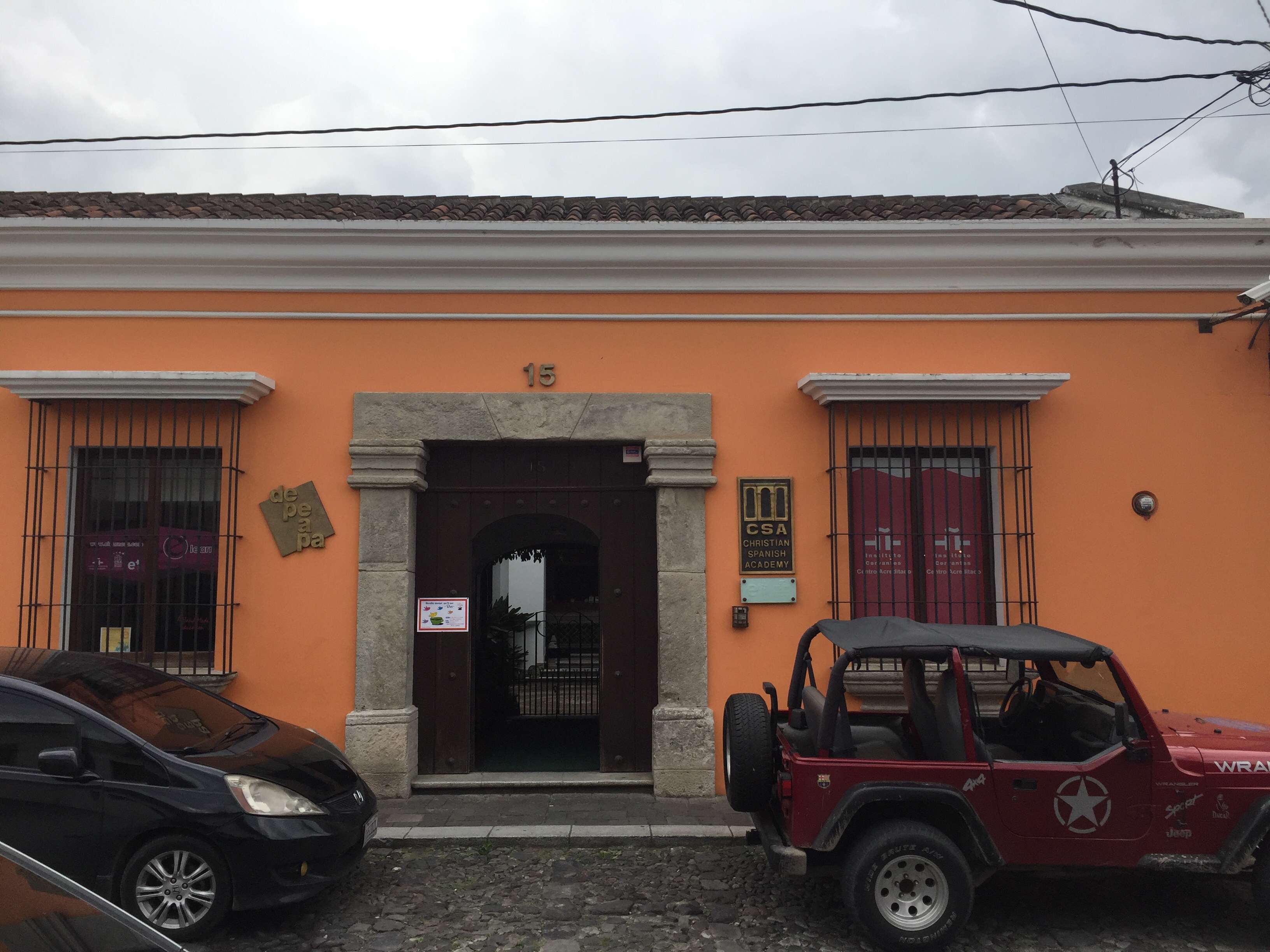
The front of the school.
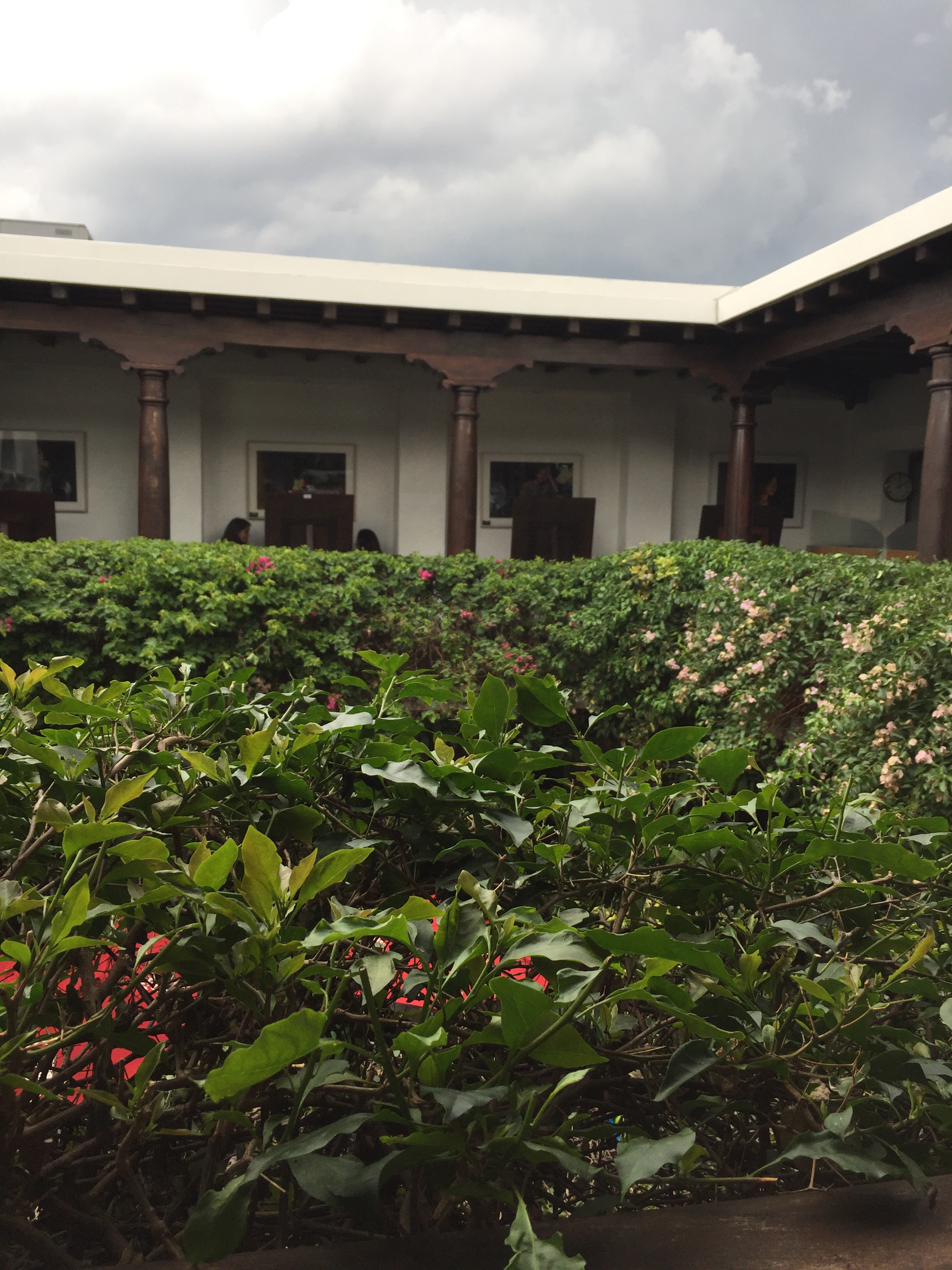
The school is built in the colonial style. Like so many buildings here, it’s got a big courtyard/garden, and everything is more or less open air. I sit upstairs with my teacher. If we stand up, we can see the peak of Volcán de Agua, and often birds fly into the climbing plants that line the balcony.
View from my seat.
My teacher and I generally spend the first hour or so of class in general conversation about whatever comes up. This is exactly what I need – the opportunity to practice using Spanish, developing my listening skills, and learning random vocabulary along the way. Often our conversations take us into territory that I’m very happy to talk about, but partway through an explanation or a story I will think, I do not have the vocabulary for this conversation!!! Then there’s a lot of creative explanation by me to use he vocabulary that I do have, or a lot of “¿Cómo se dice…?” to learn out what I need to know.
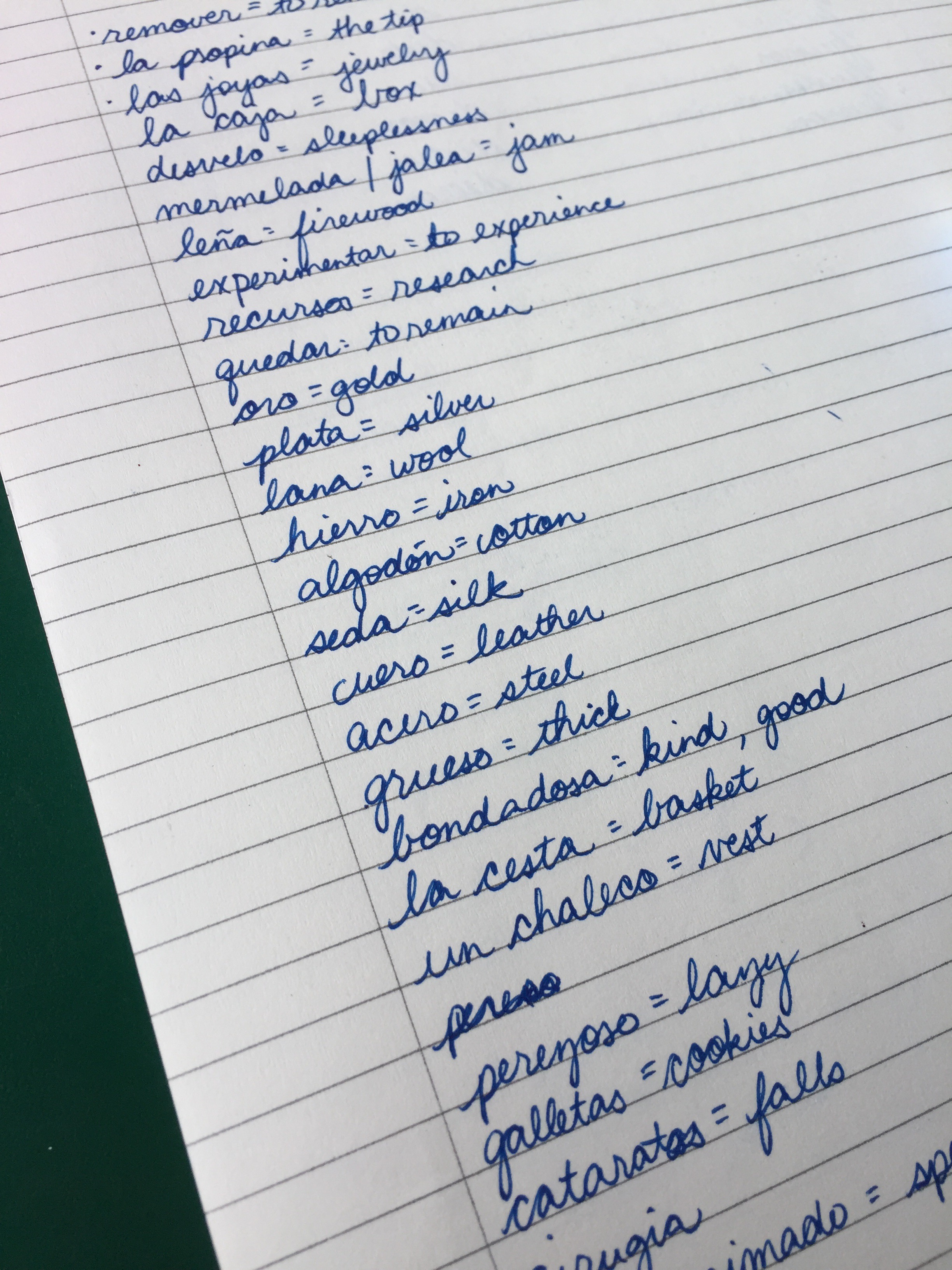
I jot down vocabulary words as I learn them to hopefully commit to memory.
I’m not kidding when I say that we have talked about incredibly diverse and far-reaching topics. Here’s a small taste:
Lots and lots about Canada, Ontario, and Mississauga – geography, culture, politics
What it was like to live through the Guatemalan civil war
How maple syrup is made
The Safe Third Country Agreement
The story of my family’s immigration to Canada
The educational system in Canada vs the educational system in Guatemala
My hike along the Niagara recreational trail earlier this spring
What it’s like to walk out on the ice on a frozen Great Lake
Ice fishing
How I use Google Classroom and technology in my classes
The Guatemalan social services system
Sometimes those conversations actually last longer than an hour. Today my teacher and I just talked for two hours, all the way until break! At 10:00, music is played over speakers, signalling break time. I head downstairs and talk with friends for a bit. Break is a quick fifteen minutes, and then we’re back to work.
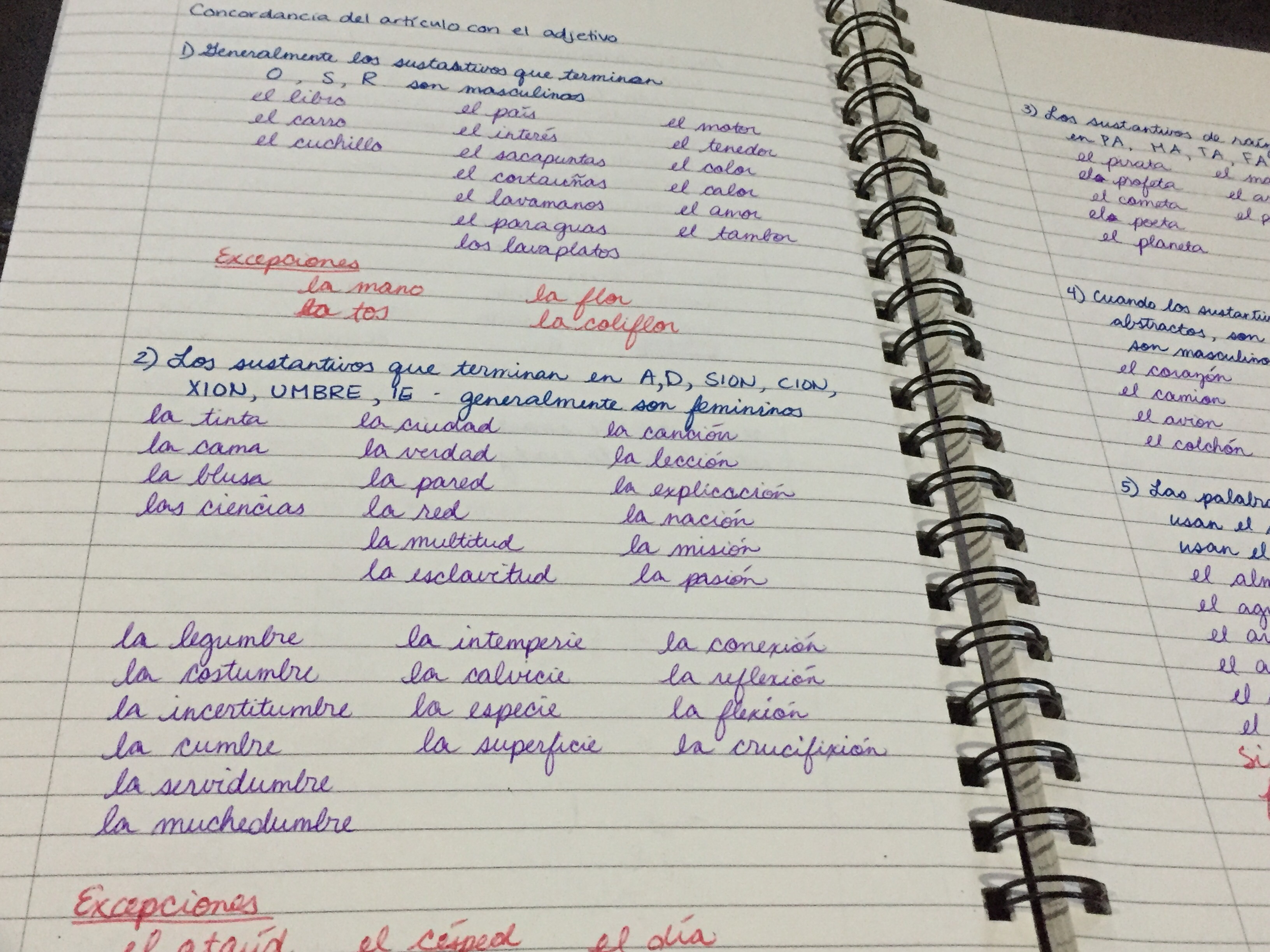
Often after break, my teacher and I will go over my homework from the night before. Then we’ll spend time learning/reviewing grammar concepts, doing activities to practice the grammar, practicing oral work (like a list of 20 or 30 questions he asks that I answer), reading exercises, and written work. I studiously take notes for any grammar concept so I can review it later on.
Gotta study hard! 🤓
At 12:00, music signals the end of classes again. My housemates and I head home together. My housemates are finished classes for the day at lunch, so they’ll often begin homework before we eat so they have lots of free time. I’ll often sit with them and study. Today I took a nap before lunch instead. 😴
We eat at one, and then I head back out for class, which begins at 2:00. My housemates, meanwhile, go off to explore. They visit ruins, take buses to little villages, or find cute cafés to sit in. I was worried about feeling left out, but the truth is that I’m happy to spend time in class. (Yes = 🤓.) My purpose in being here is to learn Spanish, and classes are the way to reach that goal. My host was skeptical that 7 hours is necessary or helpful. She told us on our first day of classes that four hours is best. After that you’re too tired and you just need to practice what you’ve learned as you shop or explore. Maybe that’s true for many people, but I think I’m a different case. I know so much scattered and random vocabulary and grammar, and classes are the way for me to put all of that into context. As my housemate Hanna said, “Your work here is to connect the dots. I’m just looking for a dot – any dot.”
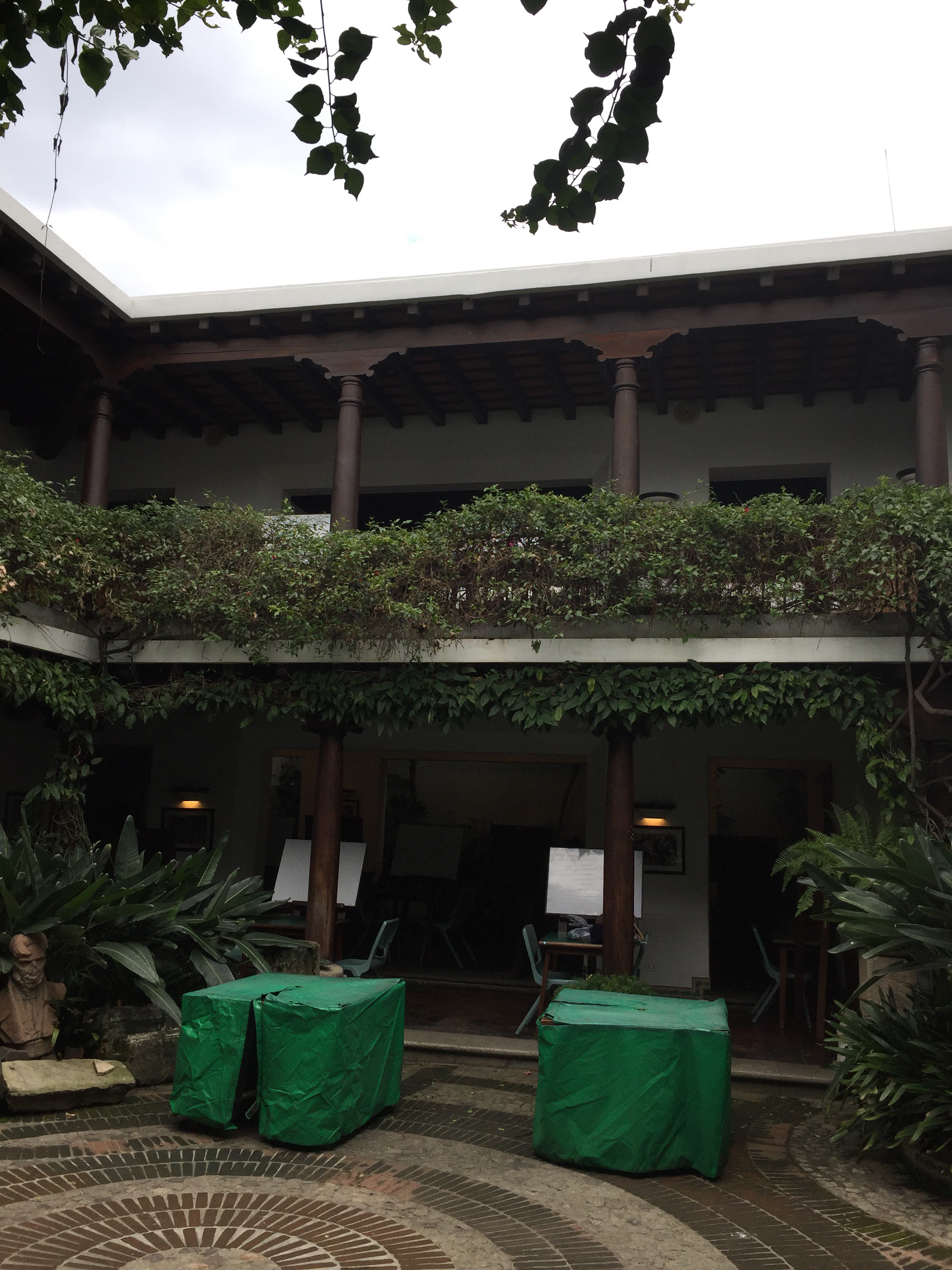
In the courtyard. Those tables get used for classes in the morning. I took this pic in the afternoon after it rained, so they’re covered and umbrellas and chairs have been put away.
Morning classes generally follow the same pattern as afternoon classes – conversation for as long as we sustain it, and then grammar or verb work, practice, oral work, listening work, written work. I finish classes at five and head toward home. I usually take a different route so that I can walk past something new and see a little something of the city on my way back home.
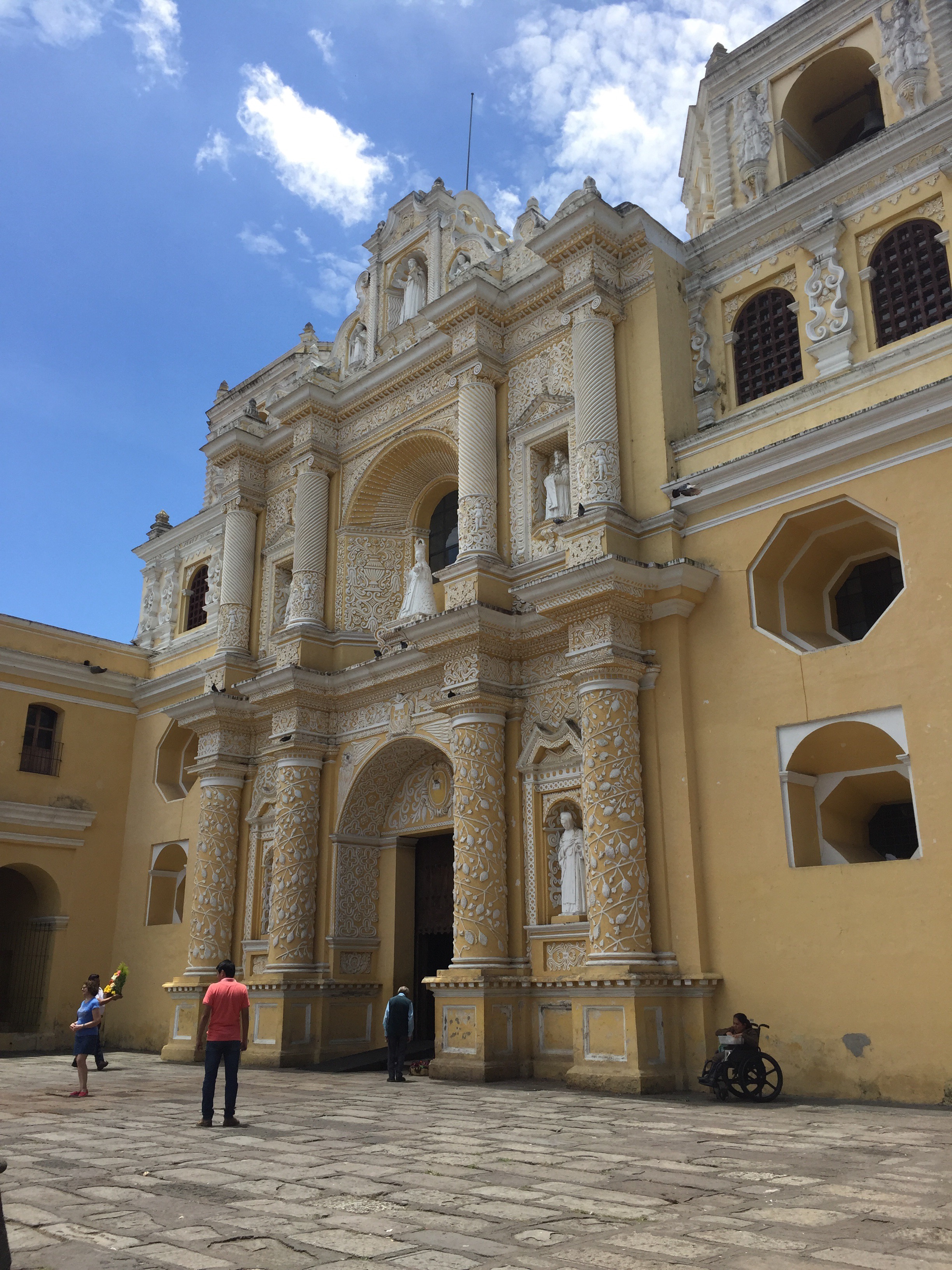
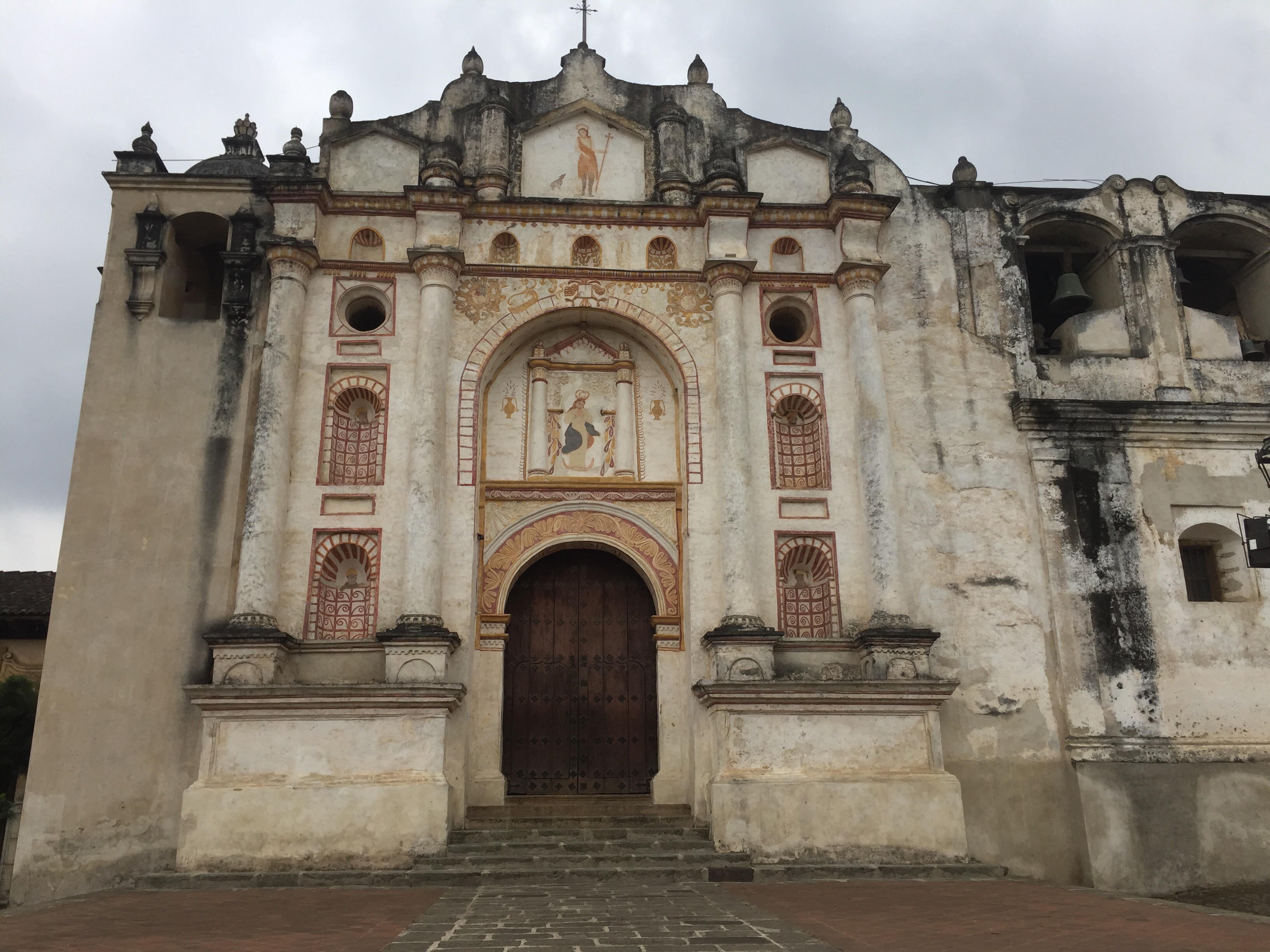
This is the church I visited on my way home yesterday.
Once home, I begin my homework. Early in the week, my head was so full and homework was hard. I realized today that yesterday was different – much clearer still after seven hour of classes. I’m hoping that means I’m over the tough first learning curve. After dinner, my housemates and I often spend time studying, talking, or maybe even squeezing in a little reading. Then I fall into bed exhausted to begin the cycle anew the next day.
So, I’m down 35 hours of Spanish. 35 hours of classes to go. Bring it on! In the meantime, I’m very happy to have a weekend in order to take a break from classes, rest my brain, see the city a little, and be a tourist.
So I’m living with a family here in Guatemala. Some parts of that feel very familiar. I lived with a host family in France, too. But some parts are uniquely Guatemalan. (Or more accurately, Central American.)
For example, the front of the family’s property is a mechanic and car wash. Car washes by hand, that is. We walk through this area whenever we go out or come back home. I frequently get wet feet in my sandals! 😆
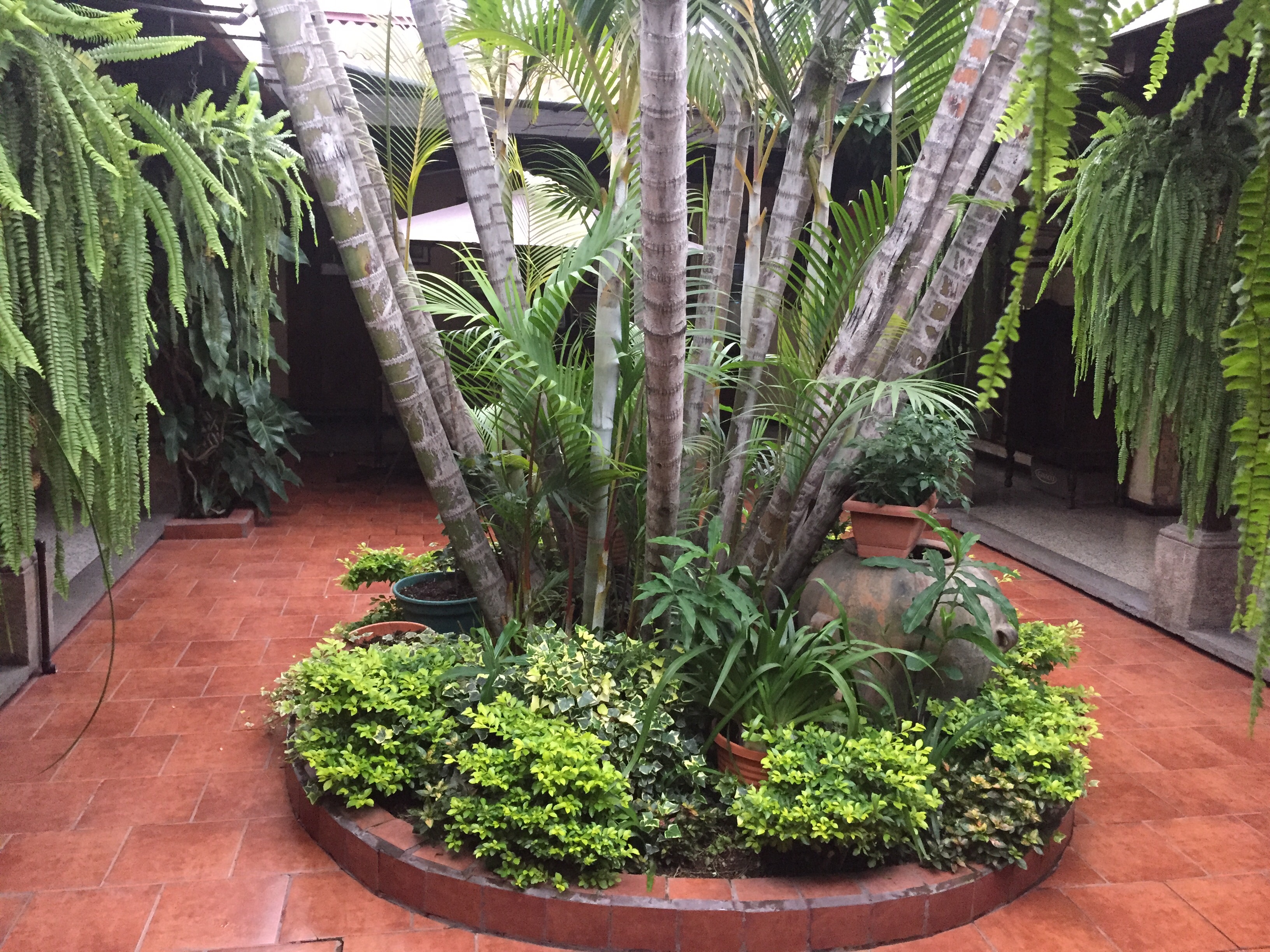
Walk in through the door of the house, and you are in a lovely courtyard. The common space is all open air, as is the entire school, too. When the temperature is around 18 to 24 all year round, that’s pretty doable!
We’ve got couches under the roof overhang, as well as a patio table and chairs set where we often do homework.
We’ve got a lovely dining room, with a big enough table for all seven students and the host “parents”.
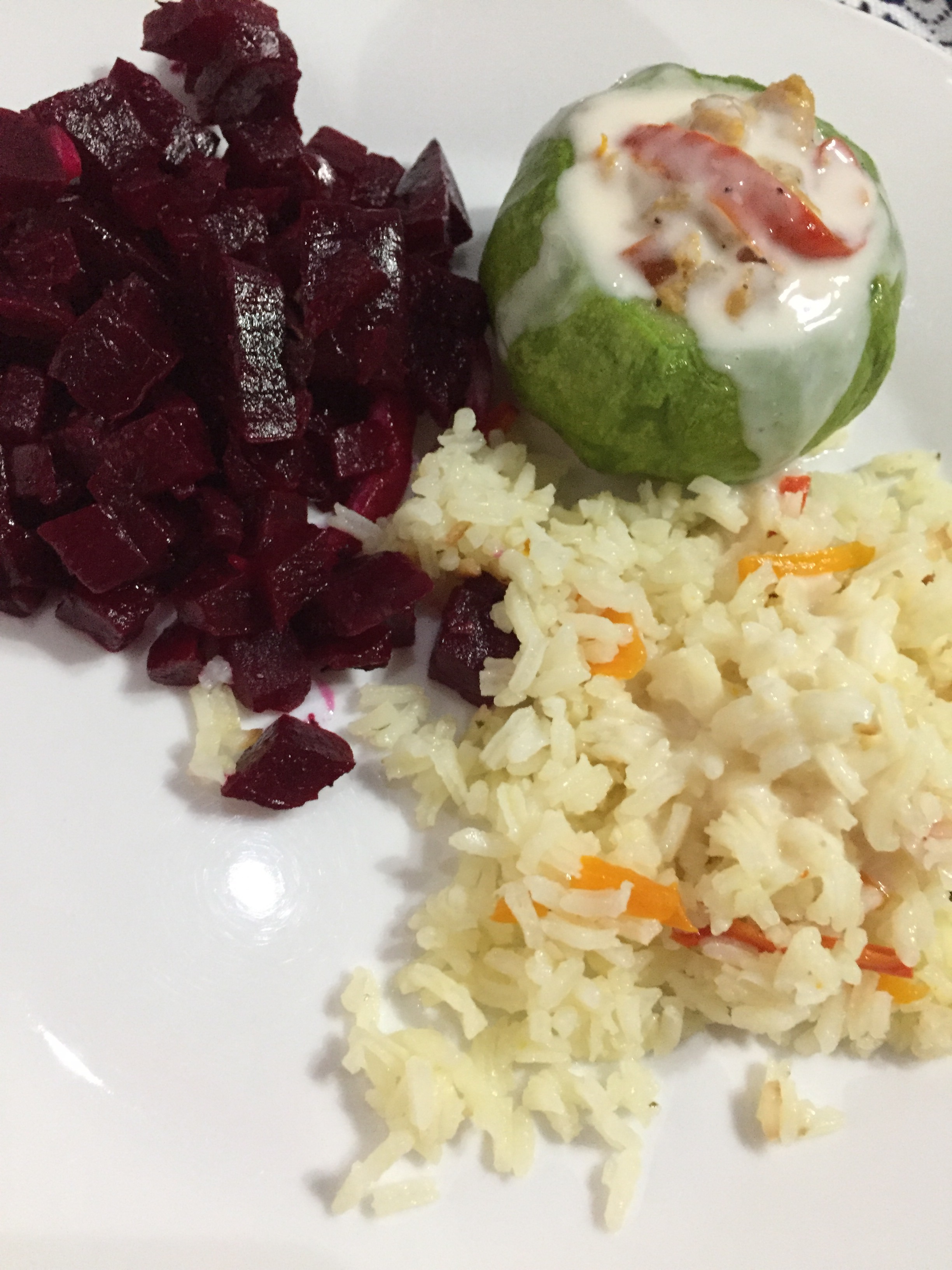
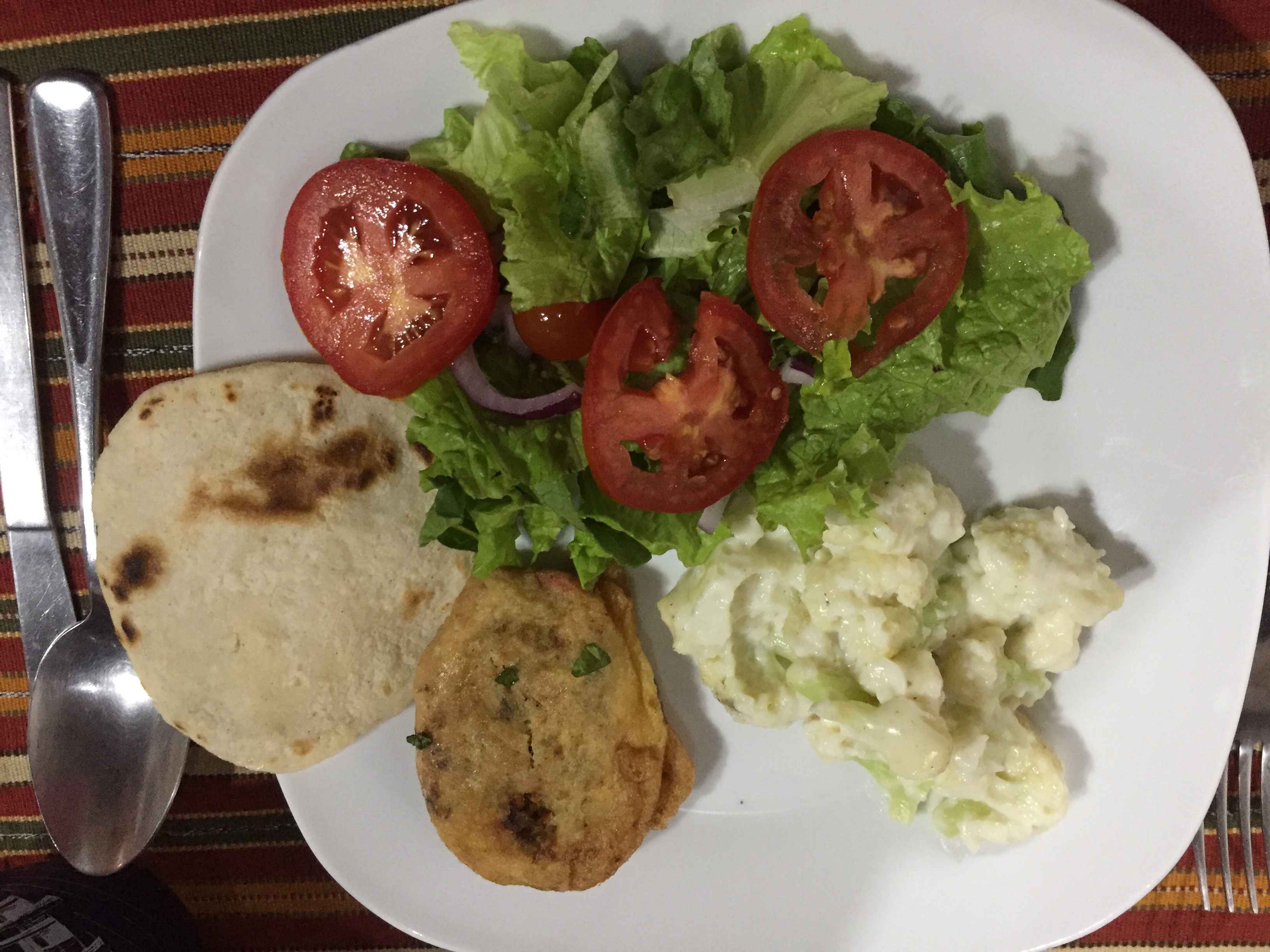
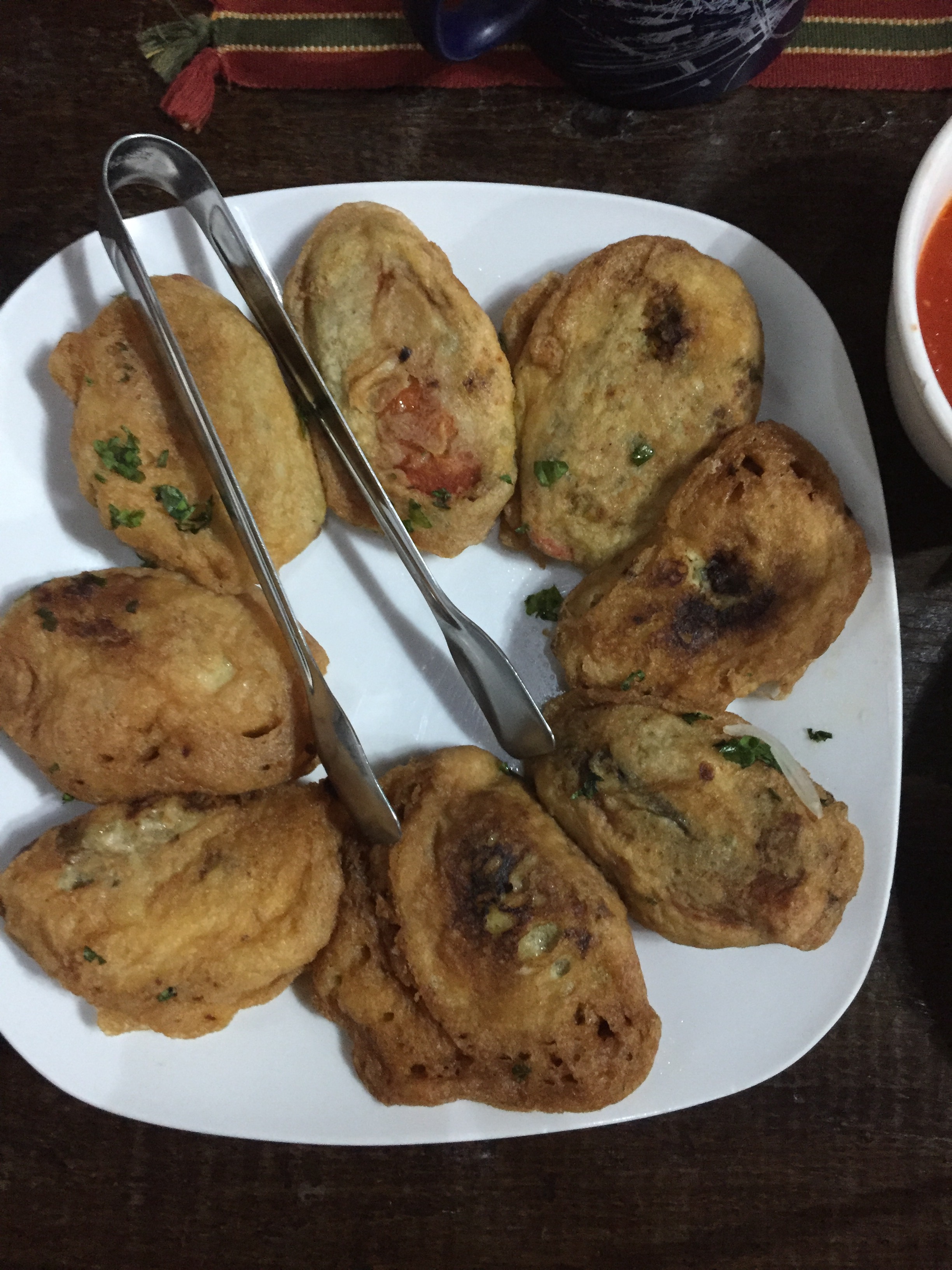
And that’s what we really need to talk about. My host has the gift of hospitality. She ensures that our every need is taken care of, starting with amazing food at every meal. I didn’t start taking pictures of food at our first meals (good manners meant I didn’t take my phone to the table!😆), and I regret it because those were some impressive, beautifully presented meals! Each meal is delicious and beautifully plated for us! Here are a few to “when your appetite”, so to speak…
Each meal also comes with a different fresh juice – many which I’ve never had before. Strawberry juice? I’ve had that out of a juice box as a fake “flavour”, but never juice made from fresh strawberries! Blackberry, papaya, cantaloupe, hibiscus tea… and the desserts! You can see in one photo above the individual dessert crepes we got at lunch yesterday.
(Side note: at the start of a class, both morning and afternoon, my teacher will often ask how my day was and what meals we ate. I do not have the Spanish vocabulary to adequately describe what we are experiencing. So I can say we had chicken and rice last night for dinner and chicken and rice today for lunch, but he has no idea that those meals were totally different gourmet food.)
Annette’s hospitality goes far beyond food. The first morning of classes, one of my housemates came to breakfast with a wrinkly shirt. Annette immediately demanded that she hand it over so it could be ironed before we left for classes. That happened again this morning, too.
Annette has made sure we have extra blankets for the evening chill. She has called the school to make sure we’re showing up on time for classes. She gives advice about what tourist sites and villages are worth going to and which experiences are not. She affectionately calls us “mis niños“, my children, and she has made us genuinely feel like family, at home in a foreign country. She is a truely gracious host, and I appreciate her so much.
Basically, we’re being treated like royalty here. Going home to real life is going to be a reality check!
It’s hard to believe that it’s only been three days so far here in Guatemala. Life immediately began to follow a very specific routine. Breakfast. Spanish classes. Lunch. Spanish classes. Dinner. Spanish homework. Fall into bed with a full brain. Repeat.
Because I walk to school or back home four times a day, the area of the city where I live has quickly become very familiar. Today I found myself stuck behind an obvious group of tourists who didn’t know where they were going, and I was immediately annoyed. They were taking up the whole sidewalk and taking loudly in English. I had to remind myself, uh, Beth, you’ve only been here three days. You’re one of those tourists, too!
This afternoon, classes differed from the regular routine. My teacher Jorge and I went on a trip to San Juan del Obispo. We met up at school, but then we walked through the city to the south to catch a “Chicken Bus”. These are school buses that are transformed into more or less public transit. They’re not anything official, but everyone uses them. In general, a guy stands in the open doorway yelling out the location that the bus is going to. So we took the chicken bus partway up Volcán de Agua. (Let me insert an aside here: it felt very strange to be having Spanish conversation out in public. My conversations have all been in the safety of the school, where only my teacher is paying attention, and anyone else overhearing is either a teacher or a student. Regular conversation out in public was a lot riskier!)
So, up in the village of San Juan del Obispo, my teacher and I went to a convent and museum. I was trying to read the signs, but my teacher also wanted to talk about them (and reading Spanish required a little more concentration than English!). A sister from the convent came along and chastised Jorge for not giving me a good enough tour. She took over, and so my official tour was done by a nun! She was really good about speaking clearly and slowly and asking me if I understood. It was fascinating to hear the history of the convent and some of the work the church did in the area. At a certain point in the tour, I realized that the only responses I was giving were ah, sí, mmhmmm. So I tried out some questions and actually got some practice speaking with other people! 😊🤓
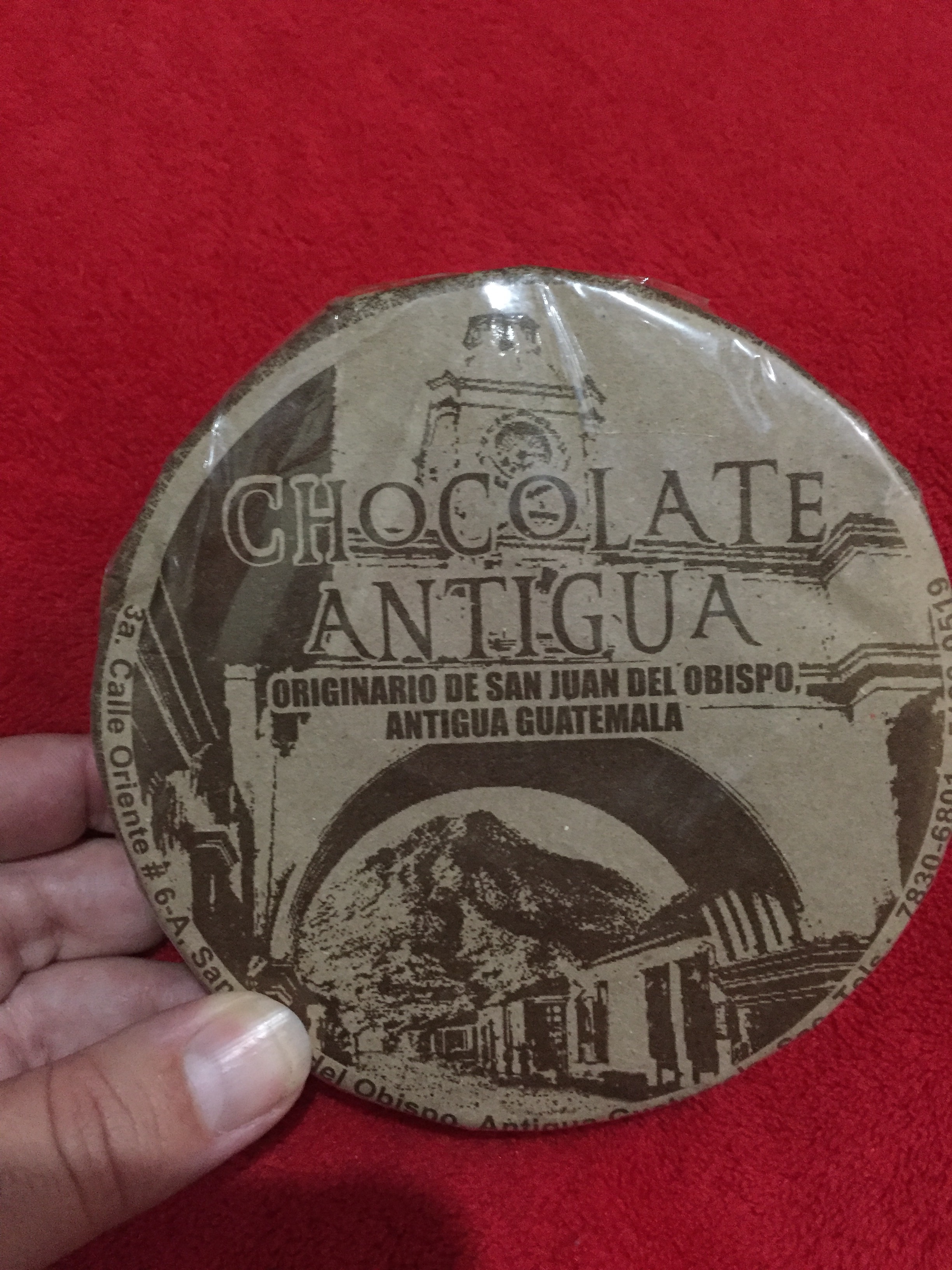
After the tour of the convent, Jorge and I walked down to a artisanal chocolate factory. I’m calling it a factory, but I don’t really know what to call it. Let me explain. Once again, a woman inside took over the touring and explanations. She showed me raw cocoa, talked about how it’s toasted, and then demonstrated how toasted cocoa crumbles easily. We got to taste some too. (Spoiler alert: it was pretty gross. Like eating unsweetened bakers chocolate. Because that’s pretty close to plain old toasted cocoa!)
Then we saw the machine that’s used to grind the cocoa. The chocolate they make is all organic, so basically all that’s added is sugar, plus the option of different spices. You could have chocolate with vanilla, or ginger, or chilli, or macadamia, or rice. Yep, rice! That’s a very traditional option, apparently.
From there, the chocolate is worked by hand into round disks about the size of a teacup saucer. We got to watch a bunch of people working, each taking a different step of rolling, flattening, rounding, and finishing. The disks are then stacked and dried for a couple of days before they get wrapped and brought to market.
Back in the sales room, I got to try a couple of samples. I wanted to taste the rice option, because mentally I had pictured a chocolate bar with chunks of rice in it. The rice is actually ground up along with the cocoa. It’s an interesting flavour – not like the chocolate covered rice I imagined! 😆 I didn’t buy that kind though!
After we took the bus back down to Antigua, there was only a half hour of regular class time left. Instead of sitting and working, we decided (I decided) to call it quits for the day. That left me with enough time to curl up in the couch in the courtyard and actually have enough brain power to blog before supper!
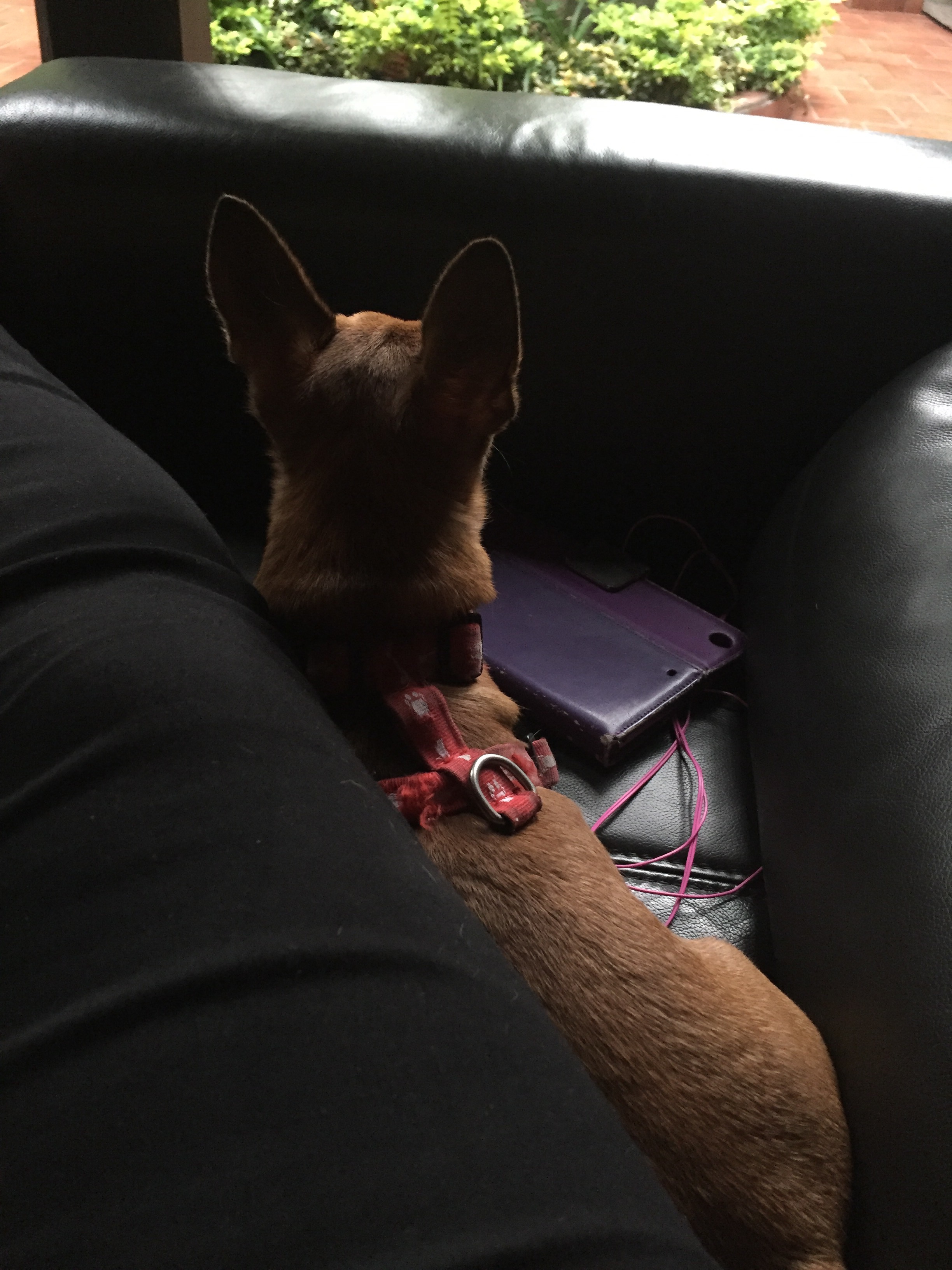
And who should come and climb up beside me? This little pup. We are not friends. He likes to nip at heels when any of us students walk around. But apparently he really wants to make friends! We’ll see about that.
At 100 years old and wheelchair-bound, my grandmother might not immediately appear to be a valourous woman. Even in her youth, she barely topped five feet. She never learned to drive. She left school after grade six to work in the family bakery. But don’t let those facts mislead you: my grandma is most certain a woman of valour.
My grandma was born two months into the First World War. She was a middle child, and I can easily imagine her bickering with siblings as she fought to find her own place in the family. (Yes, I speak from experience as a middle child.)
At age eleven, Grandma left school and began work in the family bakery. There was work to be done and there were family members to feed, and Holland in 1925 was maybe not the easiest place for a girl to pursue her education. Grandma spoke with pride in her later years that even though she left school so early, she was still an avid reader and was knowledgeable about many subjects. She did not let the lack of schooling stand in her way.
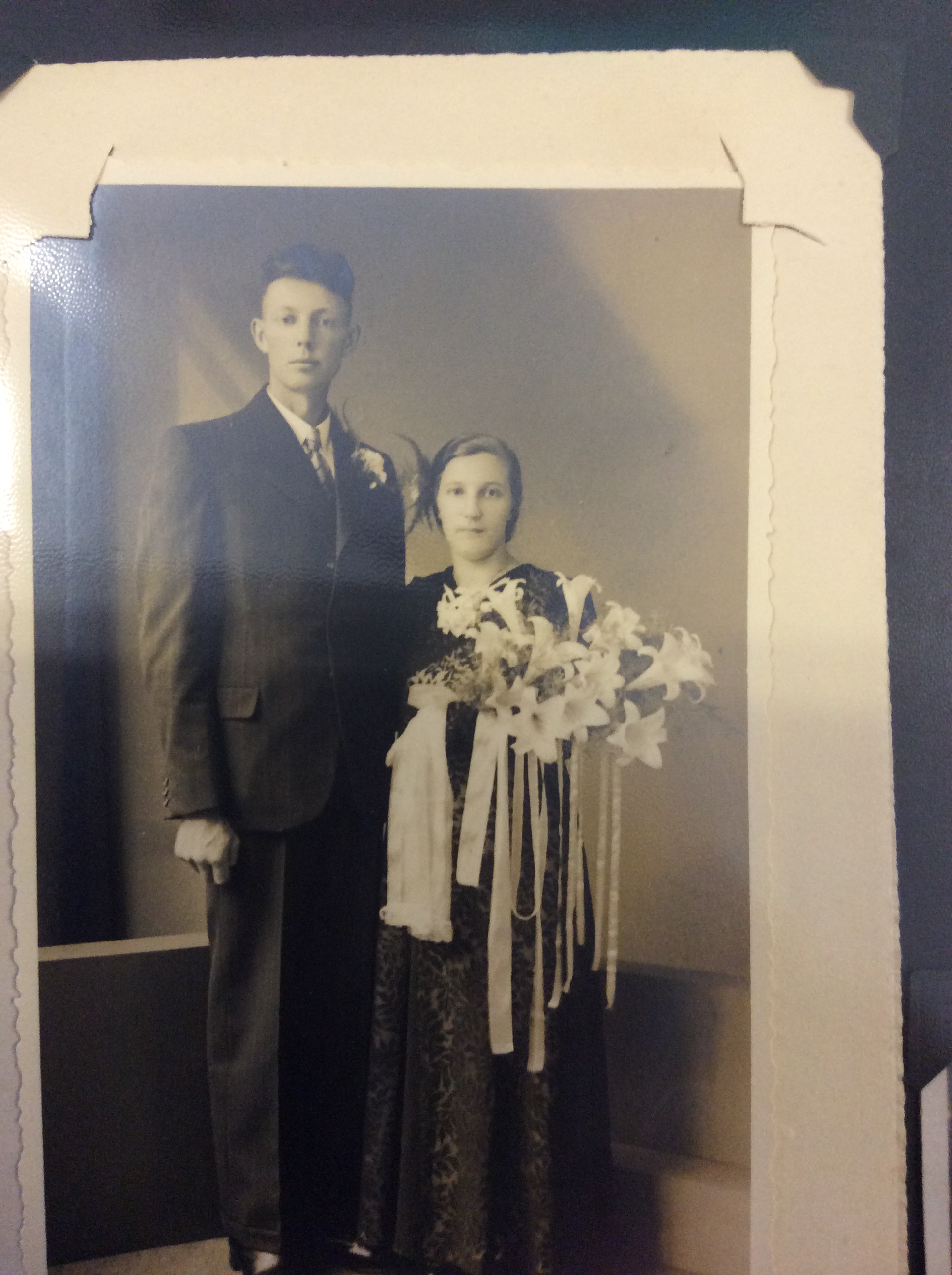
Grandpa and Grandma’s wedding
My sisters and I once asked Grandma how she met Grandpa. She told us that she and her friends were giggling over a group of boys, and my grandma told the others, “I like the long one.” Over six feet tall, my grandpa did rather tower over his wife. My grandpa and grandma enjoyed a long marriage, celebrating their 48th wedding anniversary before my grandpa’s death in 1989.
Grandma and Grandpa at their 45th wedding anniversary
Grandma and Grandpa were married two months after the Netherlands was invaded by Germany during the Second World War. Throughout the war, Grandma and Grandpa lived with the fear that Grandpa would be captured by German soldiers and brought to work in German factories or worse. Their first child was born during the war, a stillborn son. Their second child, a son name Jan (John), was also born. Trintje (Tena) followed two years later, and Bregtsje (Betty) was born just after the end of the war. My dad, Jabik (Jacob) was another two years later in 1948.
The babies were brought to the church to be baptized as soon as possible, on the Sunday after their birth. As women were supposed to stay at home on bed rest, Grandma did not see her children’s baptisms, but told us later that she knew the baptism had been completed when she heard the church bells begin to ring, signalling the end of the service.
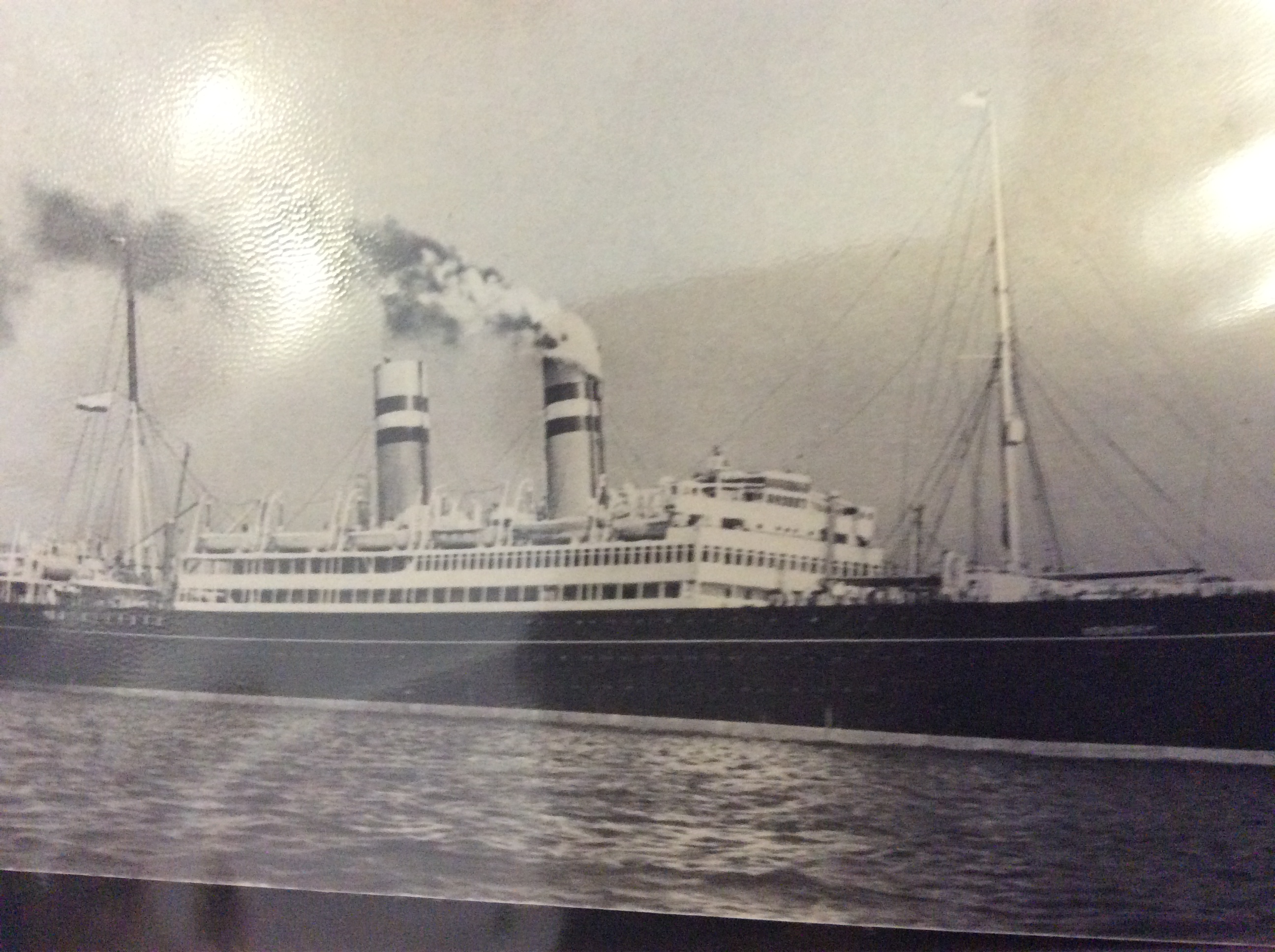
In May of 1950, filled with hope and expectation, and what must have been a whole lot of trepidation, Grandma and Grandpa and their children set off for a new home on a new continent. Immigrating to Canada meant a new chance for their family, but also new and unfamiliar things in almost all of life. I can only imagine what trust and courage this required from my grandparents as they stepped out in faith, following God’s leading.
The SS Volendam
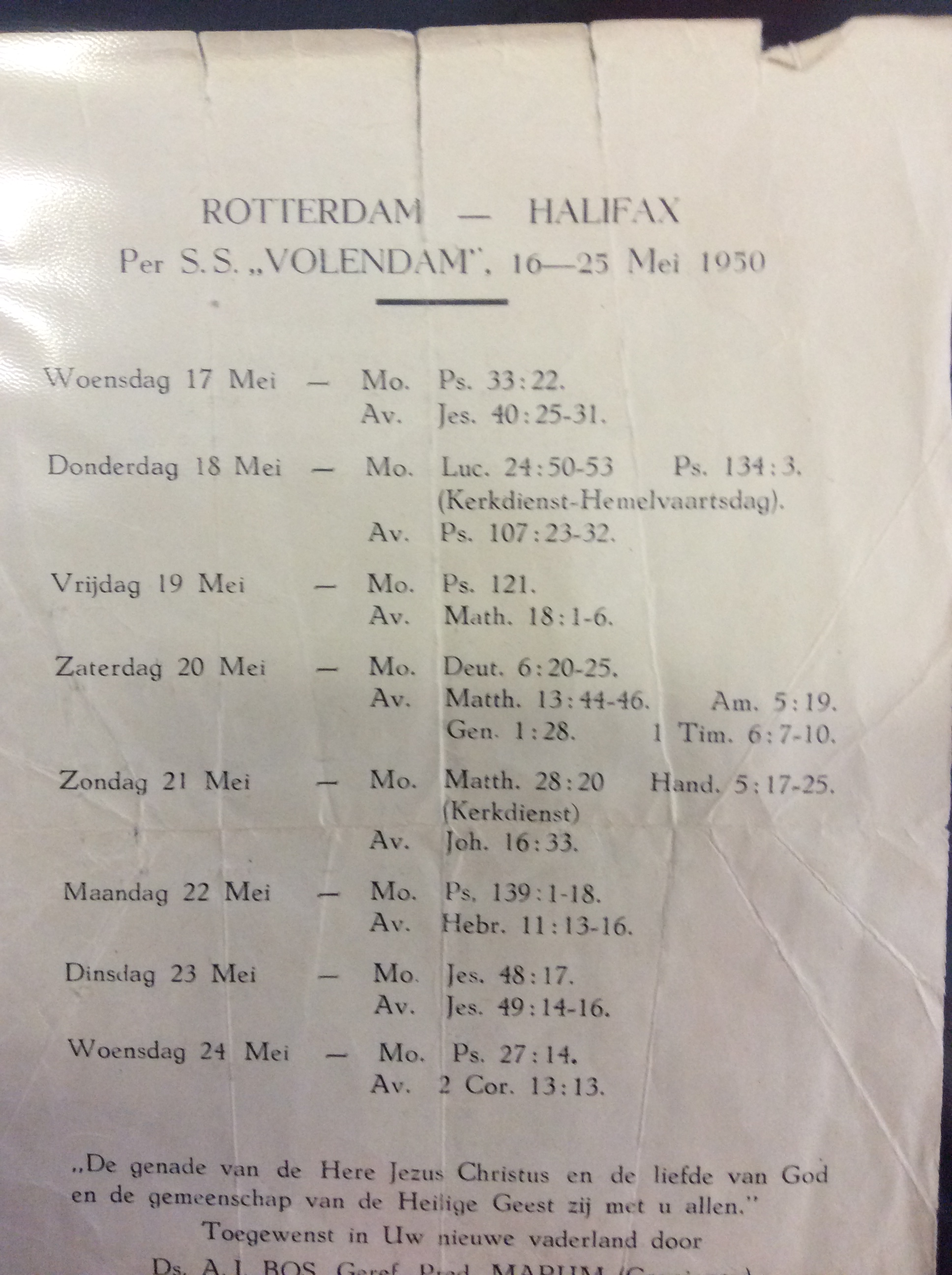
A sheet of suggested Bible readings was given to passengers on the Volendam as they sailed 8 days across the ocean. On the first day at sea, Grandma opened her Bible and read these words from Psalm 33:22…
Let your unfailing love surround us, Lord,
for our hope is in you alone.
Here, laten Uw goedheid en liefde ons nooit verlaten,
En wij willen U altijd blijven verwachten.
The Bible reading sheet has been carefully saved, even 64 years later
In a new country, Grandma and Grandpa pursued a new life as they continued to trust God’s direction and put their hope in God alone. Moving from place to place so they could earn a living, provide a warm home for their children, and eventually fulfill Grandpa’s dream of having their own farm, they were active members of multiple churches in southwestern Ontario.
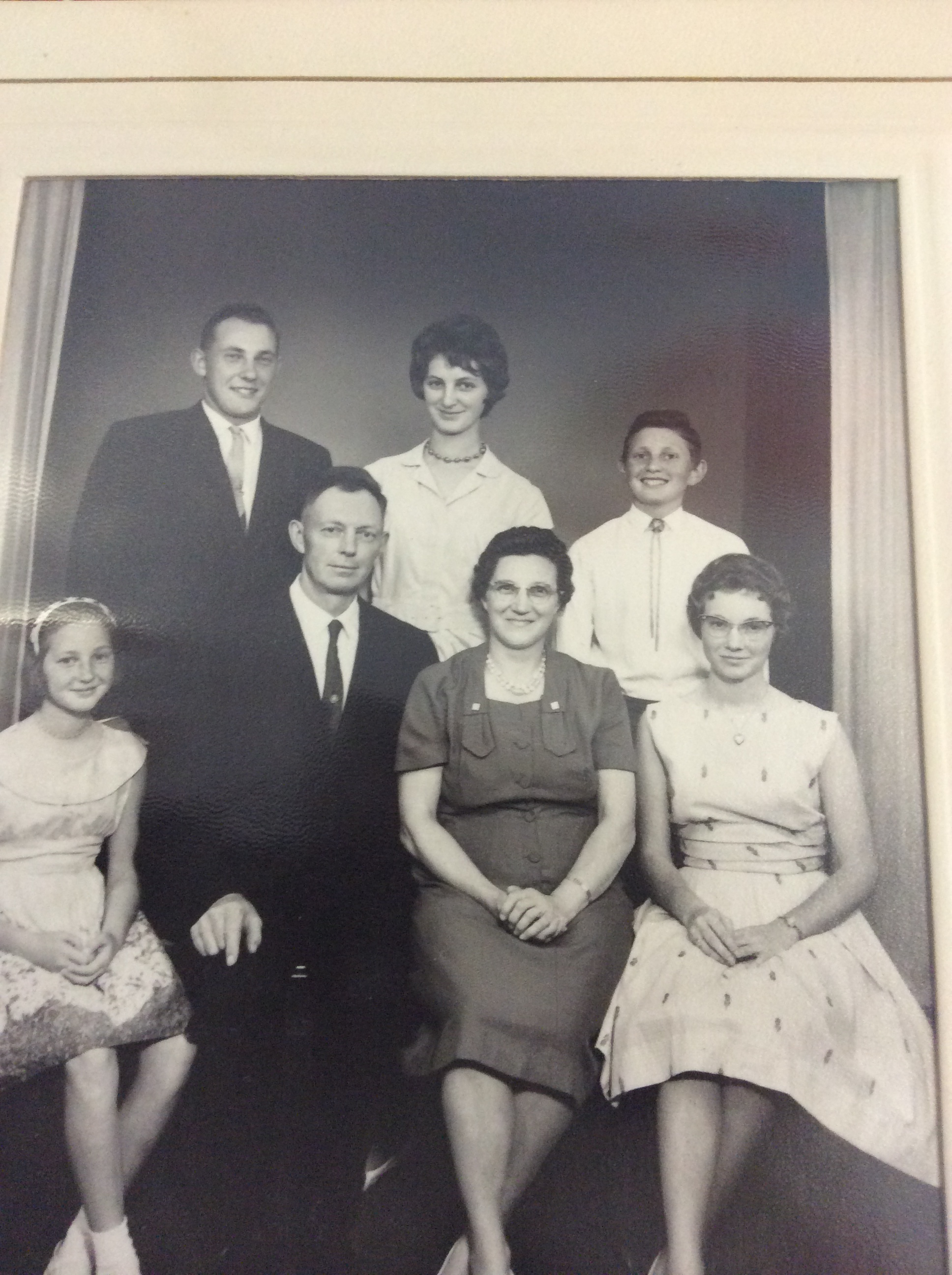
A family picture
By the time that I was born, Grandma was already 68 years old. My dad once told me that he regretted that his father was quite old when he was born, because Dad was quite young (at 40) when his father died. Despite the age gap between Grandma and me, I was so blessed to grow up with no geographic gap between us. Grandma lived just a few houses down from us for my first thirteen years of life, and she plays an immense role in my childhood memories.
I will never forget the times spent at her house on Sundays either in between church services or after the afternoon service until Dad came to pick me up at 7 or 8. Grandma and I would eat a simple supper together, and then spend the rest of our time playing games. It was the same games almost every time, often played in the same order. Grandma would also use the same moves each time in Chinese Checkers, and yet I was never what the outcome of the game would be. Uno can never be played now without remembering Grandma’s insistence on not using the “nasty cards” (making an opponent pick up cards or skip a turn was not a nice way to play!).
Since Grandma didn’t drive, we picked her up each Sunday after Grandpa’s death to bring her to church. Grandma didn’t like the heavy full-size hymnal that was in the church pew, so she had her own small hymnal that she carried in her purse. A favourite way to pass the drive was to pick out hymns to sing with Grandma as we made our way into town each Sunday. (Of course, I cannot tell that story without mentioning that my dad worried about my apparent lack of musical ability during these impromptu hymn-sings!)
As Grandma entered her late 90s, she began to have difficulty speaking in English. A Dutch speaker until her mid-30s, she had had a late start in her second language. She could still understand English, but Dutch most often came out of her mouth. This often causes frustration for me when I go to visit her, because I understand only minimal Dutch.
I will also always remember the pain of the first time that I went to visit Grandma and could see on her face that she did not know who I was. I sat through the rest of that visit crying as my parents spoke with her in Dutch. My mom had to explain that I was their daughter, her granddaughter.
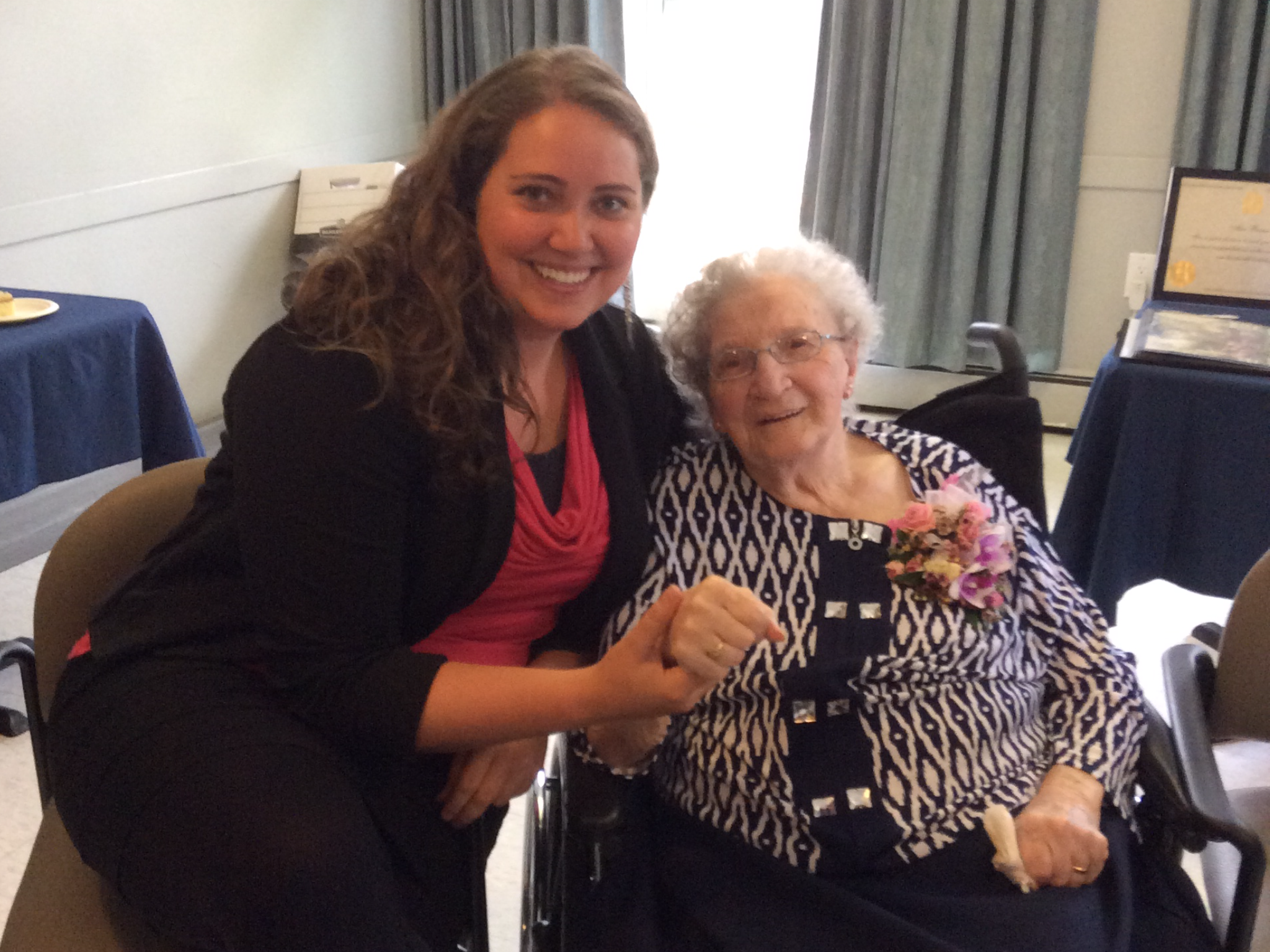
Good days still come often enough; at her 100th birthday party this past weekend, Grandma greeted me and spoke with me in English each time I talked to her. Each time I have a chance, I take the opportunity to go and visit Grandma. Even if we can’t converse, it’s enough for me to sit and hold her hand for a while.
At Grandma’s 100th birthday party this past Sunday
Singing is the best bet for memories to surface. Even on a day that Grandma can’t respond in English, she can sing along to the old hymns that we once sang long ago.
At Grandma’s 100th birthday party, one of the nurses decided to add simple clip-on earrings to Grandma’s outfit. Upon seeing them, one of my aunts declared, “That’s the first time in 100 years this woman has worn earrings!” Even when you’re 100, you’re not too old to try something new.
When Grandma turned 99 last year, I started thinking about all the ways the world has changed since she was born. She has seen and lived through so much history. She has now lived 26 years without her husband. She has lived through the loss of an adult child, in addition to the child she lost at his birth. She must be tired, ready and anxious to go to her heavenly home.
Before my aunt died a year and a half ago, her sister came to see her and said to her, “Say hi to Dad when you get home.”
“It’s one of the first things I plan to do,” was the reply.
Although thinking of Grandma going to her heavenly home brings me much sorrow, I also think of her joyful reunion with her husband and her son and daughter. And I think forward to the day that I will go home, and how I will run to see my grandma again, and laugh with joy over seeing her whole and perfect, how we will speak to each other without confusion or language barriers, how we will run and dance and laugh together, and how we will lift our voices in praise to Jesus once again.
For we walk by faith, not by sight. II Corinthians 5:7
I walked alone through the dawning day as mist swirled around me. It was not quite light enough to see easily yet, and I was carefully searching for arrows that would tell me I was on the right path. In Galicia, the most western province of Spain, mist is commonplace in the early morning. Eventually the sun causes it to disappear, but the first few hours of my day were generally spent in mist. Particularly when I was walking alone, I was aware that a lack of attention might mean missing a turn off the path and result in getting lost somewhere in the Galician countryside.
Often during these misty mornings my mind would turn to Paul’s words in II Corinthians – we walk by faith, not by sight. This was my theme verse for my journey, and it was literally true for parts of the Camino. There were times I would be walking for a while without seeing an arrow or waymark, but trusting that I was still on the right path. Or there would be places where the arrows seemed to point away from the direction that intuitively seemed right. I learned the hard way to follow the arrows. It takes faith to believe that they are leading to the final destination. We cannot see the whole scope of the journey in one view, but we trust that we will get there eventually.
In my personal devotions time about a year and a half ago, I began praying with urgency to know what God’s plans were for my future – not just the immediate next step, but I longed to know EVERYTHING God has planned for the rest of my years on earth. I am without a doubt a planner. I want to be prepared and equipped. I wanted to know ALL the good things God wants me to do, and what the timeline is for them.
The image I kept receiving from God was of the Good Shepherd leading me, one step at a time, up a rocky mountainside. The way was difficult, and I couldn’t look up from the path too much as I was walking, because I had to be concerned with where my feet were at present. The path was winding, and I couldn’t actually see where it was heading beyond the next curve. Plus the Good Shepherd was in front of me, and he was kind of blocking the view.
This was an image that kept returning to my mind throughout my journey this summer. It probably helped that I was actually climbing rocky mountainsides, but I also couldn’t help but think, if I had actually known, at the beginning of the trip, what the whole thing would be like, I wouldn’t have started. I would have given up before I began. Sometimes I think God purposely does NOT reveal everything to us. Walking by faith instead of sight is not a task given to us by a mean-spirited God, but by a heavenly Father who has our best interests at heart as he continues the sanctifying work in our lives. If we knew all the experiences that lay ahead, all the challenges, all the difficulties, would we dare continue?
God has planted eternity in the human heart, but even so, people cannot see the whole scope of God’s work from beginning to end. (Ecclesiastes 3:11) Even though we cannot see the whole scope of God’s work, we rest in God’s faithfulness.
Even when we do not know how our work will be used in the Kingdom of God, we will persist in believing that God has good works for us to do, planned long ago. Even when we do not see the changes happening in the hearts of our students, we will remain confident that the Holy Spirit is at work in each of them. Even though sometimes, the way God is leading us seems to be the opposite of the direction we should be going, we follow in faith.
God’s faithfulness in the past gives us faith today for the promises of tomorrow.
So we step out in faith, knowing that we are being created anew in Christ Jesus, knowing that long ago he planned good things for us to do, and he will faithfully lead us to those things.
Did you think I was done blogging? No, I’m not! I was given the privilege of leading staff devotions for my school. I wrote three scenes with reflections on the Camino and our school year, using the theme verse for the year, Ephesians 2:10. Here’s scene one:
For everything there is a season,and a time for every matter under heaven. Ecclesiastes 3:1
From the first time that I heard about the Camino de Santiago, I wanted to go. I’m not sure how to describe my reasons for wanting to go, and might end up saying it was like the Camino was calling to me. That’s certainly a common enough reason one hears from other pilgrims on the Camino. I believe, actually, it was God calling me to this journey.
This past year I made my plans. I bought my plane tickets in February, and things seemed certain. Then in March, I got really sick. I wondered if I was actually healthy enough to spend every day walking for more than a month. There were a lot of other things to worry about, too – would I be alone for the whole trip, or would I make friends? Would my hiking boots protect my feet, or would I suffer blisters for weeks on end? Would my back injury allow me to carry everything I needed for 40 days, or would I have to give up somewhere along the way? Was it really safe to go to a foreign country on my own?
But each time that I began pondering these what ifs, the Holy Spirit was there to bring comfort and wisdom. Sometimes that was through the prayers or encouragement of a friend, sometimes through advice from someone who had walked the Camino before. Sometimes through words of a song that would remind me of God’s faithfulness. Often through words of Scripture being brought to mind.
God’s faithfulness in the past gives us faith today for the promises of tomorrow.
God had called me to this journey. He has been totally faithful through my entire life, in fact, through all of human history and beyond. So I stepped out in faith, knowing that God’s faithfulness would continue.
As a staff gathered here today, we celebrate God’s faithfulness over the history of JKCS, over the history of each of our individual lives, over the events of our summers; and we anticipate his faithfulness to us this coming year. The summer experiences represented around this room vary widely – rest, relaxation, busyness; joy, sorrow, grief, and loss; excitement, preparation and anticipation, looking back, leaving places of employment, starting a new job or a new teaching assignment here at John Knox.
Ecclesiastes tells us there is a time for every activity under heaven…
A time to be born, and a time to die.
A time to tear down, and a time to build up.
A time to cry, and a time to laugh.
A time to rest, and a time to work.
A time to walk, and a time to lie down, I might add.
A time to say goodbye to previous staff members, and a time to welcome new ones.
A time to send students on to the next grade, and a time to face the challenges of the next group of students God entrusts to us.
God has planted eternity in the human heart, but even so, people cannot see the whole scope of God’s work from beginning to end. (Ecclesiastes 3:11) Even though we cannot see the whole scope of God’s work, we rest in God’s faithfulness.
God already knows each moment we will face, collectively and individually, this year. He knows the moments we will seek his face with great joy, being renewed in his presence and goodness. He knows the moments that we will give in to temptation, perhaps say something we later regret. He knows the student that will challenge us, push us to the limits of our patience and love. He knows the times that we will feel overwhelmed with our workload, lugging buckets of marking to and from school as we try to write report cards that might even begin to reflect on the learning and growth in our students over a term. He knows the moments our hearts will ache from criticism, and the moments when our hearts will be encouraged by the kind words of others.
Each experience will be used by God to continue to shape us into the people he is calling us to be. And we know that God causes everything to work together for the good of those who love God and are called according to his purpose for them, Romans tells us. We are God’s masterpieces – he is not content to let us stay the way we are, but calls us to be created anew, into his image. God knows each experience we will have this year. He rejoices with us in the good. He comforts us in the painful. And he uses each one to his good and his glory.
So I am aware that I’m posting this very late. And I worry that it will teach my mom the wrong lesson – if you nag enough, eventually I’ll do what you ask. But here it is, finally! Day 34
Why Hard Days are Important
Easy, good days are a balm to the soul, when everything is flying along the way it’s supposed to, and you feel like God is smiling on you and nothing can go wrong. When you feel like you can run up every mountain and conquer anything you might face.
Ah, good days. Your heart sings. Your countenance is radiant.
But then comes a hard day. Or maybe a whole series of hard days.
You slog through the day. Each step feels like it’s uphill. Each choice is a battle warring within you.
Maybe you wonder why God seems to have turned his face, his blessings, away from you. Why he’s not giving you the easy way. Why it seems like he’s not leading any more.
On easy days, a sunny attitude is the easiest thing to have.
But on the hard days, you have to choose your attitude. It’s not naturally sunny and bright. It’s not easy to rejoice in everything – you have to work at it.
But the thing is, the hard days are the days of growth.
Every athlete knows that the only way to improve is to challenge oneself physically. Muscle only grows and increases when if it is given work that is hard. A musician only gets better by practicing the skills that were once hard.
I heard once of an experiment where trees were planted inside a large greenhouse. The trees had everything that they needed – sunlight, water, nutrients. The trees grew well and quickly, and were soon tall. But then they began to fall over. Without any wind to challenge them, the trees lacked sufficient strength to stand upright.
I don’t know if this story is actually true, but it’s meaning certainly rings true. It is easy to choose the right attitude when everything is going well. Growth occurs when we choose the right attitude when things are hard. Growth happens when we choose to push forward in the right direction when we seem to be making no progress. Growth occurs when we keep doing the right things, the hard things, even when we wish we were doing anything but.
Then we can say, as Apostle Paul said, that we have learned to be content whatever the circumstances, whether plenty or want, whether ease or hardship. Because I can do all things through Christ who strengthens me.
Today’s walk was a challenging one. It was good to ponder the above things while walking, and especially remind myself that I CHOSE to do this hard thing.
If I kept the right attitude, I could find small things to appreciate and even enjoy in this hard walk – mountains and sunshine, great company, a cute puppy. I reflected on how much stronger I am than when I began this journey – hills are challenging, but not as challenging as before. This was the longest walk I’ve done yet, at 35 kilometres, but I made it and finished well, if exhausted. I also made the walk in eight hours, including stops, thanks to encouraging friends and a great leader setting a manageable, steady, but quick pace.
Tomorrow I will be walking through rain. It was frustrating to check the forecast and see storms and rain predicted for the whole day, but it is a chance again to choose the right attitude, and choose to grow.
I will choose to do hard things. And I will strive to do them well.
I must have become a crazy person. That is the only apparent explanation for walking on from Santiago, right? I could be relaxing, sleeping in a fancy hotel with my own room, sleeping in each day with a siesta each afternoon.
Instead, I chose to walk on.
There is a somewhat popular pilgrim tradition of walking from Santiago to Finisterre, another 90 kilometres. This brings the total number of kilometres from St Jean to 900 (rounding up, but come on – I have walked so many extra kilometres around towns that I’ve stayed in. I know I’ve surpassed that 900 kilometre mark this summer!)
It was an interesting decision to make, walking on. Part of my logical brain was really pushing for that rest and ease, wondering why I would give that up just to walk more.
On the other hand, what’s 90 more kilometres once you’ve walked 800? It’s really not much! What’s three more days once you’ve walked 31? I could do anything for three days, I think. Suffer through anything, I think at less positive times!
It’s also a good motivation to actually make it ALL the way across a country on foot, not just MOST of the way.
Finally, I am learning to do hard things. As you know, this has been an important lesson for me this summer, and as I got closer to Santiago, a sense that I needed to keep going was growing within my spirit.
There’s something different about walking on when almost no one knows I’m doing it. No one is expecting it. No one is checking my blog for how many kilometres I’ve walked today. It would be easier to give up – easier to convince myself this part doesn’t matter, this is not necessary.
But I press on. It is intrinsically rewarding, this walk. Parts of it are rough and hard. There are long uphill sections to challenge.
I feel strong.
Physically, my body is so ready for this. Even after a day of rest (maybe particularly because of a day of rest which my body needed), I fall back into the rhythm of walking. It doesn’t take long until I’m not even thinking about how this is “extra”.
Mentally, I feel strong. It is empowering to know that I can choose to do a hard thing, and find joy in it.
It’s really not about the destination, but about the journey. So upon reaching my destination, I kept journeying on.
One of the key things for me when I actually return home (in less than a week as I write this, but it will be closer when I actually post and you read this!), will be to learn how to continue the journey in my “regular” life.
Again, I ask myself: now that I know I avoid hard things, what are the hard things God is asking me to tackle?
But having experienced my own growth, I don’t anticipate these with trepidation. Because I know that I can climb mountains, even if it takes baby steps. Slowly but surely, I will make it.
Once again, I feel there are no words to really express what the past two days have been. But I want to write about them at least to remember them later.
I woke up earlier than I was hoping in the morning of day 31, but figured I might as well get started. Just out the door, I ran into a lovely Canadian couple. I haven’t met many other Canadians, so this was a nice treat. We walked together for quite a while. Eventually we parted ways when I stopped for a drink and a sello (a stamp for my credencial – you need to get two on your last day on the way into Santiago!). I was actually glad to walk the last 9 kilometres of the day by myself. (Another aside: the night before I had been joking with friends that our last day was only 20 kilometres. While walking those 20, I thought, 20 kilometres is still 20 kilometres. But I recovered quickly and really wasn’t tired! It isn’t much any more!)
The highest point of elevation of the day was Monte del Gozo – the Mount of Joy. For centuries, pilgrims have come over this hill to their first few of the cathedral, and they have been overwhelmed with joy. Probably not in small part for knowing that they’re about to arrive! I was thinking during this part about all the amazing things that have happened, the things I have seen, the experiences I’ve had, the wonderful people I’ve met, and above all the goodness of God I’ve known. Monte del Gozo was joy-filled, but the outward expression of that joy was a lot of tears running down my face.
From the outskirts of the city, it’s still about 4.5 km in to the cathedral. There was no rush, though, and I walked with such joy. I kind of expected to be able to see the cathedral the whole time through the city, but the narrow streets don’t allow for that. You wend your way along and don’t even need to look for signs because you just follow the hordes of pilgrims ahead at this point.
Suddenly, a turn, and there was the cathedral! It was not yet the main entrance, but I took a moment to go down the steps toward the door and just be there. A little old nun came up to me and asked me in Spanish where I was from. I told her Canada. She asked if I was alone. I told her yes. She expressed wonder at my bravery and courage for being so far away from home on a pilgrimage. Then she told me how beautiful I was – radiant from inside. Of course, my response was more tears, but that was really how I was feeling. I don’t think anything could have taken away the huge smile from my face.
A final 100 metres or so took me through the last arch and into the square of the west entrance, the famous viewpoint of the cathedral. Arriving was strange. I didn’t feel like things were really finished. I have known along every point of this journey what to do next – walk to this place, rest for tomorrow, do my laundry, find some food… But now I had nothing left ahead of me. Arriving wasn’t the moment that I thought it would be. Later discussion with friends revealed similar experiences for them, and we hypothesized that it’s because the Camino really is about the journey, not the destination.
Soon friends came into the square, and then seemed to come from everywhere. This led to a celebratory attitude. We decided to go to the pilgrims’ office to get our final stamp and compostela, but the line was ridiculously long. Instead, we found a little bar with chairs out on the terrace along the route to the cathedral where we could have a celebratory drink and watch pilgrims arrive. Of course, we saw many more friends and acquaintances, which was very joyous.
Finally when we parted I made my way down to my hotel. A room to myself … ahhhhh!!!! After a siesta I made my way back to the cathedral and found a seat inside.
It was here that I finally had my sense of arrival. I just sat for quite some time in the presence of God, and it was beautiful.
A trip to the pilgrims’ office found me waiting in a shorter line than earlier, and I officially received my compostela, along with a special one I purchased that indicates my starting point and number of kilometres.
Evening mass was followed by dinner with a large group of friends. We stayed out until midnight, which is just totally unheard of in a pilgrim routine. But we had much to discuss and reminisce about and laugh over. It was a wonderful, wonderful evening.
This morning I found the Convento de San Fransisco – Saint Francis of Assisi. It is the 800th anniversary of his pilgrimage to Santiago. This convent is offering a special compostela this year only, in honour of the anniversary. It is a wondrous thing to think of all the pilgrims, the many well-known men and women of God, and the just as devoted but unknown, who have made this journey ahead of me.
And then came pilgrims’ mass at noon today. The church was packed with people. There was celebration and thanksgiving in the air. The priest who came to serve the Eucharist on the side where I was sitting with friends was a priest who we had met walking the Camino – how heartfelt to receive the Eucharist from a friend and fellow pilgrim!
And then! The botafumeiro. The botafumeiro might be the most famous part of the cathedral, apart from the actual relics of Saint James. It was originally used to spread incense throughout the cathedral to help with the smell of pilgrims.
We had chosen our seats carefully, and the botafumeiro swung high to the ceiling and right over our heads as it came down. It was, again, a moment without words.
And then. After the mass it was time to say goodbye to the first of our friends to head out. After lunch were more goodbyes, and I know more again will come this evening, even as we look forward to more friends arriving in the next day or two. Saying goodbye to people you have met under such unique circumstances, with no likelihood of seeing them again… Most goodbyes were just teary hugs with no words that can be spoken.
Pain and delight, fatigue and strength, loneliness and friendships, sorrow and joy. The Camino has been all these things at the same time. And more besides. It really needs to be experienced to be understood. And each person’s Camino experiences are the same and yet totally different.















 bethanypasma